
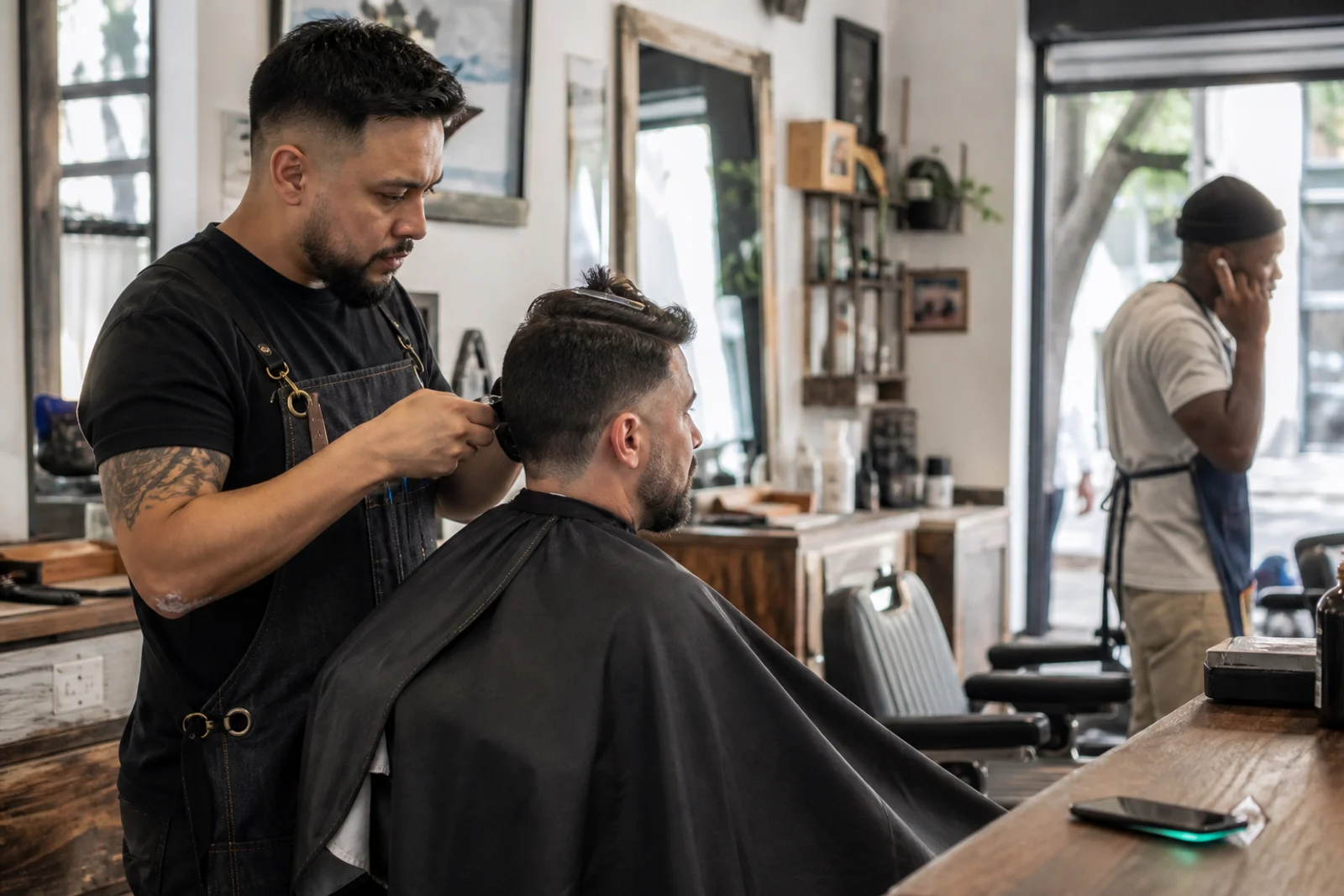
Quick answer: Barbershops and salons lose bookings to the phone for one structural reason — calls arrive exactly when everyone’s hands are busy, and 46–50% of appointments are booked outside business hours. Studies put the missed-call rate anywhere from 22% to 40% depending on methodology, and only about 24% of missed callers leave a voicemail. A human answering service costs $400–$700/month and returns messages. A receptionist costs $2,800–$4,500/month and covers 40 of 168 weekly hours. An AI receptionist answers every call, reads your live calendar, and books the appointment — most run $99–$299/month; Blismo starts at $29.99, and reports a 100% answer rate for shops using it.
Contents
What an AI receptionist actually is
Why the phone still runs these businesses
The problem, in numbers
What clients do when nobody picks up
AI receptionist vs. booking software — a different comparison
Four ways shops handle the phone
What each option really costs
How Coco works
Results Blismo reports
By business type
What an AI receptionist won’t do
Common mistakes when adopting one
How to choose the best AI receptionist
Setting it up, and proving ROI in month one
Pricing
FAQ
What an AI Receptionist Actually Is
An AI receptionist is software that answers your business phone in natural spoken conversation, understands what the caller wants, and completes the request — rather than recording a message for someone to deal with later.
You’ll see the same category sold under several names. AI receptionist software, AI phone receptionist, AI virtual receptionist, AI voice receptionist, AI front desk, and artificial intelligence receptionist all describe the same thing. The label doesn’t tell you much; what separates the products is whether the call ends with a booking or a transcript.
For a barbershop or salon, it should be able to:
Answer on the first ring, at any hour, including days you’re closed
Understand a booking request without a phone menu
Answer questions from your real service menu and prices
Check your live calendar and offer times that actually exist
Book, reschedule, or cancel during the call
Send a text confirmation and reminders afterwards
Hand off to a person when the situation calls for one
The distinction that matters most is the last step. A voicemail or answering service ends with a task for you. An AI receptionist ends with an appointment.
Coco is Blismo’s AI phone assistant. She is part of the Blismo platform rather than a standalone phone service, which is why she can see the calendar and complete a booking instead of passing on a message.
Why the Phone Still Runs These Businesses
Online booking has been available for a decade, and the phone still carries most of the intent in this industry.
57% of beauty and wellness guests book by phone (Zenoti).
77% of salon and barber regulars say calling is the easiest way to change an appointment (Zenoti; BookingBee, 2026).
Even shops with good online booking keep taking calls, because clients ring for the things a booking widget can’t resolve:
Checking availability for one specific barber or stylist
Asking what something actually costs with their combination of services
Rescheduling, which is fiddly to self-serve
Group bookings — a bridal party, a family, four friends before an event
Anything non-standard — “I’m coming from another salon’s set,” “my kid has sensory issues,” “can you fit a beard in with the cut”
A booking page handles the simple half. The phone gets everything else — which is also the higher-value half.
The Problem, in Numbers
Most shop owners know they miss calls. Very few know the size of it, because a missed call leaves no record anywhere in the business.
| Metric | Figure | Source |
|---|---|---|
| Missed-call rate, beauty businesses | 22–27% | BookingBee, 2026 |
| Missed-call rate, peak hours (higher estimate) | 35–40% | Aira / SchedulingKit, 2026 |
| Appointments booked outside business hours | 46–50% | LeadSuiteNow, 2026 |
| Guests who book by phone | 57–70% | Zenoti; LeadSuiteNow, 2026 |
| Missed callers who leave a voicemail | ~24% | Zenoti |
| Callers who hang up after 3 minutes on hold | 52% | Zenoti |
| Average time to reschedule by phone | 8.1 minutes | BookingBee, 2026 |
| Reschedule calls transferred or bounced | 63% | BookingBee, 2026 |
| Annual revenue lost to missed calls | $15,000–$45,000+ | RingBooker, 2026 |
| No-show rate in beauty | 15–30% | RingBooker, 2026 |
A note on these figures. Published missed-call rates for this industry range from about 22% to 40%, and the studies behind them are mostly published by software vendors rather than independent researchers. Treat the range as directional. The number that matters is your own — and you can get it in ten minutes from your phone system’s missed-call log.
Two rows deserve a second look.
Only about 24% of missed callers leave a voicemail. So for every message you get back, roughly three people rang and left nothing at all. Voicemail isn’t a safety net; it’s a record of the minority who bothered.
46–50% of bookings happen outside opening hours. Roughly half of all booking intent arrives when the shop is shut.
Working out your own number
Count missed calls on one busy day. Most phone systems log them.
Multiply by days open per week, then by 52.
Apply a conservative conversion rate — say 40% of answered calls would have booked.
Multiply by your average ticket.
A shop missing six calls on each of five busy days a week, converting 40% at a $45 average ticket, is looking at roughly $28,000 a year in calls that currently ring out. Directional rather than precise — but for most owners it’s the first time the number exists at all.
Why it stays invisible
Your point-of-sale reports the appointments that happened. It has no field for the person who rang at 2pm on Saturday, got no answer, and called the shop two doors down. The loss is real, recurring, and absent from every report you look at.
What Clients Do When Nobody Picks Up
Three things, and only one of them is recoverable:
They book elsewhere. Most common with new clients, who have no loyalty to spend. This one is gone permanently, and you never learn it happened.
They give up. They meant to book, got distracted, and the intent evaporated. They may come back in three weeks, or not.
They try again later. The best case — and it still costs you, because now your staff are playing phone tag with someone who has already been inconvenienced.
The worst time to miss a call is when your chair is open. That’s the specific coincidence this problem creates: demand spikes at exactly the moment nobody is free to answer it.
AI Receptionist vs. Booking Software — A Different Comparison
Most comparisons put AI receptionists against voicemail and answering services. That’s the wrong axis for shops that already have scheduling software.
Booking software organises time that’s already been committed. It holds the calendar, prevents double-booking, sends reminders, and lets clients who are willing to self-serve book themselves.
An AI receptionist captures conversation and turns it into a booking. It works on the demand that never reaches the booking page — the caller with a question, the reschedule, the group enquiry, the person who simply prefers to talk.
| Booking Software (Vagaro, Fresha, Square, etc.) | AI Receptionist | |
|---|---|---|
| Holds the calendar | ✓ | Reads it |
| Prevents double-booking | ✓ | ✓ |
| Sends reminders | ✓ | ✓ |
| Serves clients who self-serve | ✓ | — |
| Answers the phone | ✕ | ✓ |
| Handles a question before booking | ✕ | ✓ |
| Captures after-hours callers | Only self-serve | ✓ |
| Handles non-standard requests | ✕ | ✓ |
They aren’t substitutes. A shop with booking software and no phone coverage is capturing the easy half of demand and losing the rest. This is why “we already have online booking” is not an answer to the missed-call problem — the people you’re missing are, by definition, the ones who didn’t use it.
Four Ways Shops Handle the Phone
| Voicemail | Human Answering Service | Full-Time Receptionist | AI Receptionist | |
|---|---|---|---|---|
| Typical monthly cost | Free | $400–$700 at real volume | $2,800–$4,500 | $99–$299 (Blismo from $29.99) |
| Billing model | — | Per minute, with overages | Salary + payroll | Flat monthly |
| Answers the call | ✕ | ✓ | ✓ | ✓ |
| Knows your services and prices | ✕ | Only from a script you supply | ✓ | ✓ From your configured menu |
| Sees your live calendar | ✕ | Usually not | ✓ | ✓ |
| Completes the booking | ✕ | ✕ — takes a message | ✓ | ✓ |
| Handles reschedules | ✕ | Message only | ✓ | ✓ |
| Covers evenings and closed days | Records only | Depends on plan | ✕ | ✓ |
| Covers peak hours | ✕ | ✓ | ✓ | ✓ |
| Works when that person is off or leaves | — | ✓ | ✕ | ✓ |
| Cost rises with call volume | — | ✓ Sharply | ✕ | ✕ |
| Scales to a second location | — | Higher plan | Hire again | ✓ |
| What you have afterwards | Nothing | A list of people to call back | A filled calendar | A filled calendar |
The row that decides it
Look at “completes the booking.” That single line separates the options more than cost does.
A human answering service does the first half of the job well — someone friendly picks up, so the caller doesn’t hit voicemail. Then it hands the second half back to you: read the messages, work out availability, call the client back, actually reach them (they’re at work now, or driving), and book. Every one of those steps loses people, and the callback happens hours later, by which point the client has often already booked elsewhere.
That’s the same failure voicemail produces — just delayed, and paid for.
What Each Option Really Costs
Human answering services
Headline pricing looks reasonable. Real bills usually aren’t, because these services bill by the minute.
| Provider | Published per-minute rate |
|---|---|
| Ruby | ~$4.90/min |
| AnswerConnect | ~$3.25/min |
| PATLive | ~$2.65/min |
Rates via NextPhone, 2026. Verify against each vendor’s own pricing before deciding.
Entry plans start around $50–$100/month, but included minutes run out quickly (Alliance Virtual Offices, 2026).
Overage rates run $1.25–$2.50/minute once the allowance is gone (NextPhone, 2026).
Realistic monthly cost at typical small-business volume: $400–$700/month (NextPhone, 2026).
At that rate a shop spends $4,800–$8,400 a year to receive a list of people to phone back — plus the staff time spent phoning them back.
Hiring a receptionist
$2,800–$4,500/month (NextPhone, 2026) — $33,600–$54,000 a year. It works well while that person is on shift, roughly 40 hours out of the 168 in a week. The after-hours half of demand is untouched, and so are their days off, holidays, and the gap after they leave.
AI receptionists
The category runs roughly $99–$299/month for 24/7 coverage. Published pricing from other providers:
| Provider | Published pricing |
|---|---|
| AgentZap | $109/month (Starter), $295/month (Professional), $499 setup |
| Frontdesk AI | $16/month (Basic), $79/month (Business-in-a-Box), plus usage credits |
| Blismo | $29.99 (Starter, up to 1 account), $69.99 (Standard, up to 4 accounts), $119.99 (Pro, up to 8 accounts) |
Competitor pricing as published on their own sites at time of writing.
Two things to watch. First, several AI receptionist products are phone-only — they answer but aren’t connected to a booking system, so they still hand you a task. Second, watch for setup fees and per-minute usage credits, which change the real monthly cost significantly at barbershop volumes.
Side by side, annually
| Option | Annual cost | What you get |
|---|---|---|
| Voicemail | $0 | Messages from ~24% of missed callers |
| Answering service | $4,800–$8,400 | A callback list, every day |
| Receptionist | $33,600–$54,000 | Full coverage for ~24% of the week |
| Blismo (Starter) | ~$360 | Booked appointments, 168 hours a week |
How Coco Works
What happens on a call
Answers on the first ring, in natural conversation — no phone menu, no hold music.
Works out what the caller wants — new booking, reschedule, cancellation, price question, or a specific barber or technician.
Answers from your real service menu rather than a generic script.
Checks the live calendar and offers times that actually exist.
Completes the action during the call — booked, moved, or cancelled, with no handoff.
Sends a text confirmation, then reminders before the appointment.
Escalates what it shouldn’t handle — complaints and unusual situations route to a person.
Why the mechanism matters more than the feature list
It sees the calendar, not a copy of it. An assistant working from yesterday’s export will double-book you.
It knows your service durations. A fill and a full set, a trim and a full colour, occupy very different amounts of chair time. Treat them as equivalent slots and the calendar breaks within a week.
It knows when to stop. A complaint, a dispute, a request that fits no category — these are calls where an improvised answer costs more than a missed one. Escalation is a feature, not a limitation.
Results Blismo Reports
For shops running Blismo:
100% answer rate on incoming calls
Up to 80% higher client retention
~10% monthly client growth
Two honest caveats. These are Blismo’s own reported figures, not independently audited, and “up to” is doing real work in the retention number — results vary substantially by shop, market, and how well the service menu is configured. Ask for the methodology and a reference shop before treating them as a forecast for your business.
By Business Type
Barbershops
The phone rings during exactly the hours nobody can pick up. A barber can put down clippers for twenty seconds, which is why barbershops sit at the better end of the missed-call range — but the after-hours half of demand is untouched either way. Most useful for shops without a front desk, shops with walk-in traffic competing for attention, and any shop where the owner is also cutting.
Hair salons
Longer, more variable appointments make the phone harder. A colour service can run 3–6 hours, colour correction 4–8+ hours — so getting the service and duration right on the call matters more than in a barbershop, and quoting wrong costs the whole day.
There’s a second-order effect worth naming. Salon scheduling software now encourages double-booking during colour processing — the 35 minutes a client spends developing is time the stylist is free. That window used to be when the phone got answered. Once it’s sold to another client, the last slack in the day is gone.
Nail salons
The hardest case, because the constraint is physical. Both of the technician’s hands are occupied, the client’s hands are in position, and product is curing. There is no twenty-second window. Nail salons also skew hardest toward phone bookings and walk-in traffic, which makes “do you take walk-ins?” one of the most common and most costly questions to answer badly.
Solo operators and booth renters
A booth renter pays for a chair, not a receptionist. Some salons charge extra to take your bookings and check clients in — which prices the alternative fairly clearly. For a lash artist alone in a room with a client for two hours, or a solo barber between cuts, the phone is unanswerable for most of the working day.
Multi-location groups
The economics change completely. A receptionist has to be hired per location; an AI assistant covers all of them on one configuration. The thing to check is whether the product handles location-specific menus, hours, and staff — some don’t.
What an AI Receptionist Won’t Do
It won’t fix a shop nobody is calling. If the phone rings four times a week and you catch most of them, this isn’t your bottleneck. Visibility is.
It won’t handle complaints well, and shouldn’t try. Anything emotionally charged belongs with a person.
It only knows what it’s given. Wrong prices, missing services, or inaccurate durations produce wrong answers on the phone.
It doesn’t replace a good front desk. Where one exists, AI covers what it can’t — peak hours, evenings, closed days.
Clients don’t universally prefer it. Research suggests only 8–15% of consumers actively prefer AI over a human (PCN, 2026). The honest comparison isn’t AI versus a great human conversation — it’s AI versus a phone that rings out.
It won’t make people rebook. Answering the phone fills today’s gaps. Retention is a separate problem with a separate fix.
Common Mistakes When Adopting One
The failures are consistent, and none of them are about the technology:
Loading a half-built service menu. The most common and most damaging. If “fade” is one line item with one price and one duration, the assistant will quote wrong and book wrong.
Skipping durations. Everything booked as a 30-minute slot means running 40 minutes behind by Saturday afternoon.
No escalation rule. Deciding what reaches a human — and what happens at 9pm when nobody’s there — after go-live rather than before.
Turning it on and never listening to a call. Review a handful of real calls in week one. That’s where you find the gaps in your own configuration.
Expecting it to fix retention. Answering the phone captures demand that already exists. It does not make clients come back.
Not telling staff. The team should know what the assistant handles and what will reach them, or the first escalated call is a surprise.
How to Choose the Best AI Receptionist for Your Shop
There is no single “best AI receptionist” — the right answer for a two-chair barbershop differs from a six-station salon, and again from a solo booth renter. These are the questions that separate the products. Most vendor pages won’t answer them directly, so ask.
Does it book, or does it take messages? The single most important question. Many “AI receptionists” are transcription and routing tools with a friendly voice.
Does it read live availability? Ask whether it queries the calendar in real time or works from a synced copy, and how often that copy updates.
Can it handle service variants and combinations? “How much for a full set with removal and French tips?” needs three line items added together.
Does it schedule by correct service duration? If a 30-minute trim and a 4-hour colour occupy the same slot size, the calendar breaks.
Can it book a specific staff member? Clients follow people. An assistant treating all availability as interchangeable will book them with the wrong person.
What’s the escalation rule, and how fast? Ask what triggers a handoff, and what happens at 9pm when no human is available.
Does it work with your existing number? Being forced onto a new number costs you every listing, sign, and business card you have.
What’s the real monthly cost at your call volume? Check setup fees, per-minute charges, and usage credits. A $16/month plan with per-minute overage can cost more than a $99 flat plan.
What languages does it handle, and how far into the conversation? “Supports Spanish” can mean a Spanish greeting that hands off to an English speaker. That hasn’t removed the barrier; it’s moved it thirty seconds later.
What happens to the recording and the client data? Ask where call data is stored and how it’s used.
Setting It Up, and Proving ROI in Month One
The five things that carry most of the value
A service menu with the distinctions clients actually ask about. Fade versus scissor cut versus beard trim; fill versus full set; gel versus dip versus acrylic; removal as its own line.
Accurate durations per service. Most commonly skipped, most damaging.
Staff-level availability, because clients request specific people.
Add-on pricing — beard work, colour add-ons, nail art, length and shape surcharges.
Your walk-in policy, one of the highest-frequency phone questions.
Measuring it in the first 30 days
Don’t rely on a feeling. Three numbers, all of which you can get:
Answered-call rate before and after. Pull the missed-call log for the month before you started, and the month after.
Bookings created outside opening hours. These are close to pure incremental — nobody was capturing them before.
Bookings created during peak hours while staff were with clients. Same logic.
Multiply the incremental bookings by your average ticket. If that number is below what you’re paying, the configuration is wrong or the phone wasn’t your bottleneck — both are worth knowing in month one rather than month six.
Pricing
| Plan | Price | Best for |
|---|---|---|
| Starter | $29.99/month | Up to 1 account |
| Standard | $69.99/month | Up to 4 accounts |
| Pro | $119.99/month | Up to 8 accounts |
Against the alternatives at comparable coverage: an answering service runs $400–$700/month and returns messages; a receptionist runs $2,800–$4,500/month and covers about a quarter of the week; other AI receptionist products commonly run $99–$299/month.
Frequently Asked Questions
What is an AI receptionist for a barbershop or salon?
Software that answers your business phone in natural conversation, understands the request, checks your live calendar, and books the appointment during the call — rather than recording a message for someone to handle later.
How much does an AI receptionist cost?
Most run $99–$299/month for 24/7 coverage. Blismo starts at $29.99/month. Watch for setup fees and per-minute usage charges.
How much does a phone answering service cost?
Entry plans advertise $50–$100/month, but at realistic volumes the true cost runs $400–$700/month, because these services bill per minute with overages of $1.25–$2.50/minute.
Is an AI receptionist cheaper than an answering service?
Substantially. The more useful difference is what you get: an answering service returns a callback list, an AI receptionist returns booked appointments.
How much does hiring a receptionist cost?
$2,800–$4,500/month, or $33,600–$54,000 a year, covering roughly 40 of the 168 hours in a week.
How many calls do barbershops and salons actually miss?
Published estimates range from 22% to 40% depending on the study and whether it measures peak hours or all hours. The figure that matters is your own — pull the missed-call log from your phone system.
Isn’t voicemail enough?
No. Only about 24% of missed callers leave a voicemail, so roughly three in four leave no trace at all. Voicemail records the minority who bothered.
Why do so many bookings happen after hours?
Because clients book when they’re free, not when you are. 46–50% of appointments are made outside business hours.
We already have online booking — do we still need this?
Yes, if the phone still rings. Clients call for the things a booking page can’t resolve: availability for a specific stylist, pricing on a combination of services, reschedules, group bookings, and anything non-standard. Those are also the higher-value bookings.
What’s the difference between an AI receptionist and booking software?
Booking software organises time that’s already been committed. An AI receptionist captures conversation and turns it into a booking. They solve different halves of the problem and most shops need both.
Can an answering service book appointments for me?
Usually not. Most take a message, because they don’t have access to your live calendar.
Will clients know they’re talking to AI?
Modern systems use natural, low-latency conversational voice. Many shops disclose AI use in the greeting for transparency; it doesn’t meaningfully change booking completion.
Do clients prefer talking to a human?
Generally, yes — research suggests only 8–15% of consumers actively prefer AI. But the realistic alternative for most of these calls isn’t a human; it’s an unanswered phone.
What happens if the AI can’t handle something?
It should escalate to a person rather than improvise. Complaints, disputes, and unusual requests are not good automation candidates.
Can it handle reschedules and cancellations?
Yes, and this matters more than it looks — a reschedule by phone takes an average of 8.1 minutes, with 63% of those calls transferred or bounced.
Does it release the old slot when someone reschedules?
It should. That step is most often forgotten in a manual process, and it determines whether the vacated slot can be refilled.
Can it book a specific barber or stylist?
It should check that person’s live availability rather than treating all slots as interchangeable. Ask this specifically when comparing products.
Does it work with my existing phone number?
Most modern AI receptionists work with your existing number. Confirm before committing — a forced number change costs you every listing and sign you have.
Does Coco speak Spanish?
Blismo’s phone assistant supports English and Spanish. Ask any vendor how far the language support goes — a Spanish greeting that transfers to an English speaker hasn’t solved the problem.
Will it quote prices correctly for combined services?
It depends on the product. A cut plus beard, or a full set plus removal plus art, needs the components added together, not one generic price read out.
Does it reduce no-shows?
Indirectly, through automatic confirmations and reminders. No-show rates in beauty run 15–30%; reminders are the standard first countermeasure, deposits the second.
Does it replace my front desk?
Usually it covers what a front desk can’t — peak hours when everyone is with a client, evenings, and closed days.
Does it work for multi-location groups?
The economics improve with scale, because a receptionist is a per-location hire and an AI assistant isn’t. Check that the product handles location-specific menus, hours, and staff.
Is this worth it for a single-chair shop or booth renter?
Often more than for a large shop, because a solo operator has nobody to cover the phone at all.
Is there a free AI receptionist?
Some products offer free trials or limited free tiers, but a genuinely free AI receptionist that books appointments doesn’t really exist — voice minutes cost money. The realistic question is whether a paid plan costs less than the bookings you currently lose.
What’s the best AI receptionist for small business?
It depends on whether you need bookings or just call coverage. General-purpose AI front desk products handle calls across any industry, but they don’t know what a fill or a balayage is and aren’t connected to your calendar. For appointment-based businesses, a receptionist built into the booking system completes more of the job.
Is an AI virtual receptionist the same as an AI phone receptionist?
In practice, yes — the terms are used interchangeably. What differs between products is calendar access, service-level configuration, and escalation.
How long does setup take?
The work is in the configuration — service menu, durations, staff availability, add-ons, walk-in policy. Getting those five right is most of the job.
How do I prove it’s working in the first month?
Compare answered-call rate before and after, count bookings created outside opening hours, and count bookings created during peak hours while staff were with clients. Multiply the incremental bookings by your average ticket.
What results does Blismo report?
A 100% answer rate, up to 80% higher client retention, and around 10% monthly client growth. These are Blismo’s own reported figures rather than independently audited results, and they vary by shop — ask for methodology before treating them as a forecast.
What should I ask before buying any AI receptionist?
Does it book or just take messages, does it read live availability, does it schedule by correct service duration, can it book a named staff member, and what is the real monthly cost at my call volume?
Get Started with Coco
If a caller has ever hung up because nobody could take the call, that wasn’t a lost conversation — it was a lost client, and you almost certainly never knew it happened.
Coco answers every call, checks the real calendar, and books the appointment. From $29.99/month.