
About Coco
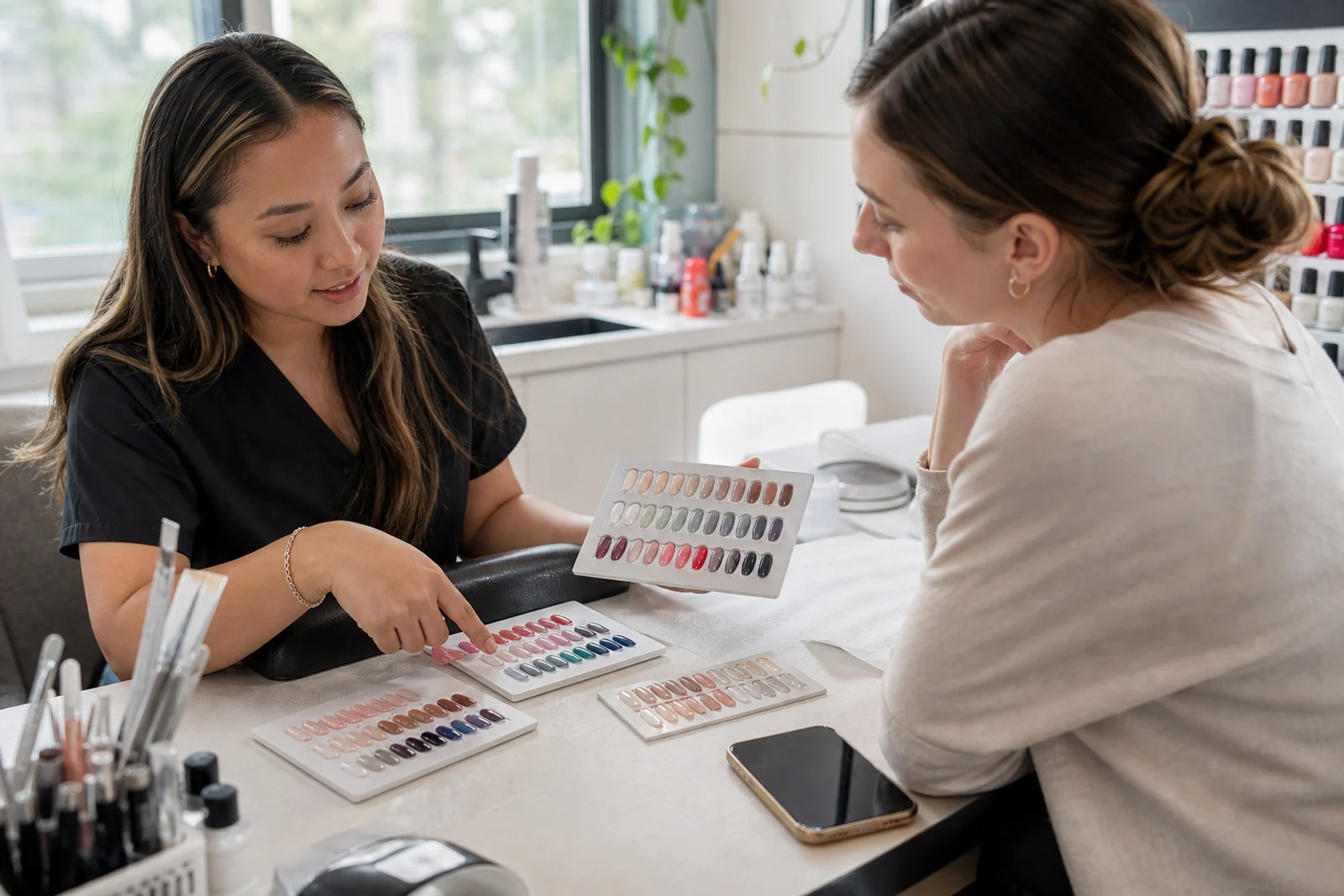
Coco is Blismo's AI phone assistant for nail salons and beauty businesses. She answers calls 24/7, works from your real service menu and pricing, checks live availability, and completes the booking during the call. For pricing questions specifically, that means the caller gets a correct number rather than an estimate from whoever grabbed the phone.
Why Nail Pricing Is Uniquely Hard to Answer
A barbershop has maybe five services. A nail salon has forty, and they combine.
Consider what "how much for a full set?" actually requires you to establish:
| Variable | Options | Price Impact |
|---|---|---|
| System | Gel, dip, acrylic, polish | Often $15–$40 spread |
| Removal | None, own set, another salon's set | Usually an add-on charge |
| Length | Natural, medium, long, XL | Frequently tiered |
| Shape | Square, almond, coffin, stiletto | Sometimes surcharged |
| Art | None, accent nails, French, full design | Anywhere from $5 to $50+ |
| Tech level | Junior, senior, specialist | Tiered pricing is common |
Six variables. The caller usually specifies one. So the "quick price question" becomes a five-minute conversation — during which a technician has stopped working and a client in the chair is waiting.
What Goes Wrong on These Calls
The quote comes out too low. Someone says "$45" for a full set, the client arrives wanting a coffin-shape long acrylic with French tips and a removal, and the real price is $95. Now you either eat the difference or have an uncomfortable conversation — and either way the visit starts badly.
The quote comes out too high. A tech quotes the top of the range to be safe. The caller hears $120, says "let me think about it," and calls the salon down the road.
The call takes too long. Five minutes on the phone is five minutes of interrupted service, and nail salons already miss an estimated 22–27% of calls because nobody's hands are free (BookingBee, 2026).
Nobody books. This is the most common outcome and the most overlooked. The caller gets a number, says thanks, hangs up — and the salon has spent five minutes providing free market research to someone who is now comparing you against two other salons.
The Thing Most Salons Get Wrong
A price call isn't a pricing question. It's a booking opportunity that gets treated as an information request.
The caller has already decided they want their nails done. They're not researching a category — they're choosing between salons. By the time they've heard the number, they're either booking or leaving, and what happens in the next fifteen seconds decides which.
Most salons stop at the number. The call ends, everyone's polite, and nothing happens.
What converts is finishing differently:
"A full set with gel runs $75, and with the removal you mentioned it'd be $90. I've got Thursday at 2 or Friday at 5:30 — shall I put you down for one?"
Same information. One extra sentence. That sentence is the difference between a price enquiry and a booking, and it's the sentence that gets skipped when someone is answering the phone with wet gloves on.
What Coco Does With a Pricing Call
Asks the clarifying questions in order — system, removal, length, art — instead of quoting blind.
Answers from your configured menu, so the number is your number, not an approximation.
Quotes combinations correctly — full set plus removal plus art, added up, rather than one line item.
Explains what changes the price, which builds trust rather than sounding evasive.
Offers real available times immediately after the quote.
Books it, in the same call.
Works after hours — and 46–50% of nail bookings are made outside business hours (LeadSuiteNow, 2026).
Where This Changes the Outcome
| Call | Typical Result | With Coco |
|---|---|---|
| "How much for a full set?" mid-Saturday | Rings out, or a tech stops mid-service | Answered and booked |
| "Do you charge extra to take off another salon's gel?" | Uncertain answer, caller hesitates | Exact removal pricing quoted |
| "How much with French tips and a removal?" | Rough estimate, often wrong | Combination priced correctly |
| Caller compares three salons | You gave a number and no reason to choose you | Number plus two available times |
| 9pm price question | Voicemail | Answered and booked |
| Same question, four times a day | Four interruptions | Zero |
The Case for Publishing Prices Anyway
Worth saying, because it reduces this problem at the source: a lot of these calls happen because your prices aren't findable.
Nail salons often keep pricing off their website, usually reasoning that the variables make it impossible to state cleanly, or that they'd rather have the conversation. Both are understandable. But the practical effect is that every price-curious client has to call, which floods a phone line nobody can answer during service hours.
A clear online price list — with ranges and the factors that move them — filters out the pure price shoppers and leaves you with calls that are closer to booking. It doesn't eliminate pricing calls, and it shouldn't. It reduces them to the ones worth taking.
Frequently Asked Questions
How much should a nail salon charge for a full set?
It varies enormously by market and system, with 2026 services commonly running $70–$120+. The more useful question is whether your pricing is stated consistently — the cost of an inconsistent answer is higher than the cost of being slightly above or below the local average.
Why do pricing calls take so long?
Because "full set" has at least six variables — system, removal, length, shape, art, and tech level — and callers typically specify one. Each one has to be established before a number is accurate.
Should I quote a range or a specific price?
A specific price for the specific service they described, after asking. Ranges sound evasive and invite a follow-up call; a blind flat quote creates a dispute at checkout.
Should nail salons list prices online?
Generally yes. Hidden pricing pushes every price-curious client onto a phone line nobody can answer mid-service. Publishing ranges with the factors that move them filters the calls down to the serious ones.
Can Coco quote combinations, like a full set with removal and art?
Yes — she works from your configured service menu and adds the components rather than quoting a single generic price.
What if my prices change or I run promotions?
Update the service menu and the answers change with it. This is more reliable than expecting every technician to remember the current promotion.
Why don't price callers book?
Usually because nobody asked them to. The call ends with a number instead of two available times, so the caller leaves to compare — and compares you against a salon that did ask.
Do clients mind being asked clarifying questions about price?
No — it reads as competence. What frustrates callers is a vague answer, or a quote that turns out to be wrong when they arrive.