
About Coco
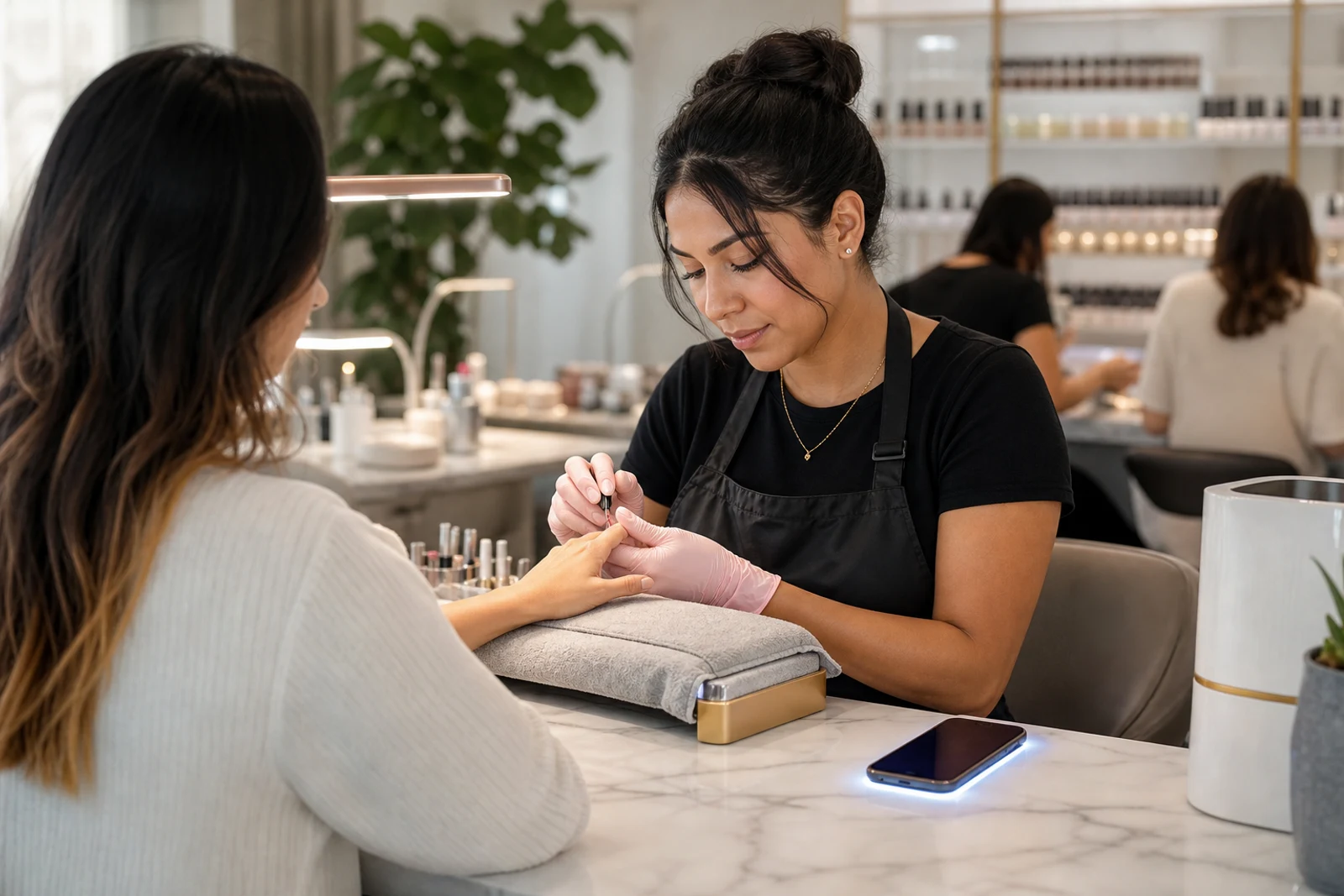
Coco is Blismo's AI phone assistant for nail salons, barbershops, and beauty businesses. She answers incoming calls 24/7 in natural conversation, understands what the caller wants — a booking, a reschedule, a price question — checks the live calendar, and completes the appointment during the call. No phone tree, no voicemail, no callback list waiting at the end of the day.
Why Nail Salons Miss More Calls Than Most Businesses
Most "missed call" advice assumes the problem is being busy. For nail salons it's more specific than that: the work physically prevents answering.
- A manicure typically runs around 45 minutes, and gel or acrylic services considerably longer (Zenoti, 2026) — a long uninterrupted window where the phone simply rings out.
- Beauty businesses miss an estimated 22–27% of calls, with smaller salons at the worse end because there's nobody free to pick up (BookingBee, 2026).
- A busy nail salon missing 5–10 calls per peak day loses an estimated $15,000–$45,000+ a year — and most of it never appears in POS reporting, because a missed caller never becomes a line item (RingBooker, 2026).
That last point is why the problem persists. The salon's reports show the appointments that happened. They can't show the ones that rang out at 2pm on a Saturday.
The Physical Reality: Why "Just Answer It" Doesn't Work
| Business Type | Hands Free During Service? | Can Pause Mid-Service? | Realistic Ability to Answer |
|---|---|---|---|
| Nail salon (gel/acrylic) | No — both hands occupied, product curing | No — timing-critical steps | Very low |
| Nail salon (basic manicure) | No | Briefly, awkwardly | Low |
| Barbershop | One hand momentarily | Yes, briefly | Low–moderate |
| Retail counter | Yes | Yes | High |
A barber can set down clippers for twenty seconds. A nail tech mid-application often cannot — the product is setting, the client's hands are in position, and stopping means redoing work. This is a structural constraint, not a discipline problem, which is why "train staff to answer faster" never fixes it.
When the Calls Actually Come In
The timing makes it worse. Nail salon demand is heavily phone- and after-hours-driven:
- 60–70% of nail clients book from a phone (LeadSuiteNow, 2026).
- 46–50% of appointments are booked outside business hours (LeadSuiteNow, 2026) — meaning roughly half of booking intent arrives when the salon is closed entirely.
Put those together and the picture is stark: a large share of enquiries arrive when nobody is there, and much of the rest arrives when everybody's hands are full.
What Coco Does Instead
- Answers on the first ring, in natural conversation rather than a menu.
- Understands the request — new booking, reschedule, cancellation, price or service question, or a request for a specific technician.
- Checks the live calendar and offers real times rather than promising a callback.
- Completes the booking during the call, so nothing waits for someone to get free.
- Sends a text confirmation, followed by reminders — which matters because no-show rates in beauty run 15–30% (RingBooker, 2026).
- Works after hours and on closed days, covering the half of demand that arrives outside opening times.
Nail Salon Answering Service for English Calls
A basic answering service may take a message or forward a call. For a booking enquiry, that still leaves someone at the salon to call back, check the right technician, and confirm a time. Coco can use the salon's configured services and live availability during an English conversation, complete the booking, and send a confirmation.
Before relying on English call coverage, test the phrases clients actually use: “fill,” “full set,” “removal,” a named technician, and walk-in availability. Configure the correct prices and durations, then decide how to hand off a complaint, an unusual request, or a quote the assistant cannot confirm. A useful answering flow finishes routine bookings and sends uncertain questions to a person instead of guessing.
What Changes for a Nail Salon
| Situation | Without an AI Receptionist | With Coco |
|---|---|---|
| Saturday peak, every station busy | Call rings out; no voicemail left | Answered and booked |
| Mid-gel application | Nobody can stop; phone ignored | Answered without interrupting service |
| 9pm enquiry | Voicemail nobody hears until morning | Booked that evening |
| Closed day | Missed entirely | Handled |
| Client wants a specific tech | Requires someone who knows the schedule | Checked against the live calendar |
| Price question about a fill vs full set | Interrupts a technician | Answered from your configured service menu |
Why This Matters More Than Booking Software Alone
Plenty of nail salons already have online booking, and it helps. But it doesn't address the callers — and phone remains a dominant channel in this industry, with 60–70% of clients booking from a phone. An online booking page catches the clients who were already going to self-serve. It does nothing for the person who rings at 2pm because they want to ask whether you do dip powder before committing.
Coco covers that gap: the caller gets an answer to their question and an appointment, in the same call.
What to Set Up First (Nail-Salon Specific)
An AI receptionist performs in proportion to how well it's configured, and nail salons have a few details that generic setups miss:
- Service menu with the distinctions clients actually ask about. Fill versus full set, gel versus dip versus acrylic, removal as a separate line item. These are the questions that trigger calls in the first place.
- Accurate service durations. A fill and a full set occupy very different amounts of chair time; if the AI books them as equivalent, the calendar breaks.
- Technician-level scheduling. Nail clients follow specific techs more often than most service categories, so requests for a named person need to check that person's real availability.
- Add-on handling. Nail art, French tips, and extended designs change both price and duration — worth configuring so quotes are accurate.
- Removal policy. "Do I need to book extra time if I'm coming from another salon's set?" is a routine question that a well-configured assistant answers and a generic one fumbles.
- Walk-in policy. Tell the assistant when to invite a walk-in, when to offer a booked time, and when staff need to confirm capacity.
Getting these six right covers the overwhelming majority of inbound nail salon calls. Anything beyond them is genuinely worth escalating to a person.
Estimating What This Is Worth to Your Salon
You can work this out with numbers you already have, rather than relying on industry averages:
- Count missed calls on one busy day. Most phone systems log them.
- Multiply by days open per week, then by 52.
- Assume a conservative conversion rate — say 40% of answered calls would have booked.
- Multiply by your average ticket.
A salon missing six calls on each of five busy days a week, converting 40% at a $60 average ticket, is looking at roughly $37,000 a year in calls that currently ring out. That figure is directional rather than precise — but it's usually the first time an owner sees the number at all, because missed calls never appear in the POS.
Frequently Asked Questions
Why do nail salons miss so many calls?
Because the work physically occupies both hands for extended periods. A manicure runs around 45 minutes with timing-critical steps, so there's often literally nobody able to pick up — beauty businesses miss an estimated 22–27% of calls overall.
How much revenue does a nail salon lose to missed calls?
Estimates put it at $15,000–$45,000+ per year for a salon missing 5–10 calls on a peak day. Most of it is invisible in normal reporting because missed callers leave no record.
Isn't online booking enough?
It helps, but it only captures clients who already intend to self-serve. With 60–70% of nail clients booking from a phone, and many calling to ask a question before committing, the phone channel still carries a large share of intent.
Can Coco answer service-specific questions, like the difference between a fill and a full set?
Yes — Coco works from the salon's configured service menu and pricing, so she answers from real information rather than a generic script.
Can Coco answer English-language nail salon calls?
Yes. Coco can converse in English using the services, prices, schedules, and policies the salon configures. Test common client phrasing and define a handoff for anything it cannot confirm.
How is an AI receptionist different from a basic answering service?
A basic service may take a message or forward the call. Coco can check live availability and complete a routine booking during the call, then send a confirmation.
Does Coco handle requests for a specific technician?
Yes. Requests for a particular tech are common in nail salons, and Coco checks the live staff schedule rather than deferring the question.
What about after-hours enquiries?
That's where a large share of the opportunity sits — roughly 46–50% of appointments are booked outside business hours. Coco covers those hours without anyone working.
Will clients realise they're speaking to AI?
Coco uses natural, low-latency conversational voice. Salons can disclose AI use in the greeting for transparency; it doesn't meaningfully change booking completion.
Does this replace my front desk?
Usually not. Most salons use Coco to cover what a front desk can't: peak hours when everyone is with a client, evenings, and closed days.