
About Coco
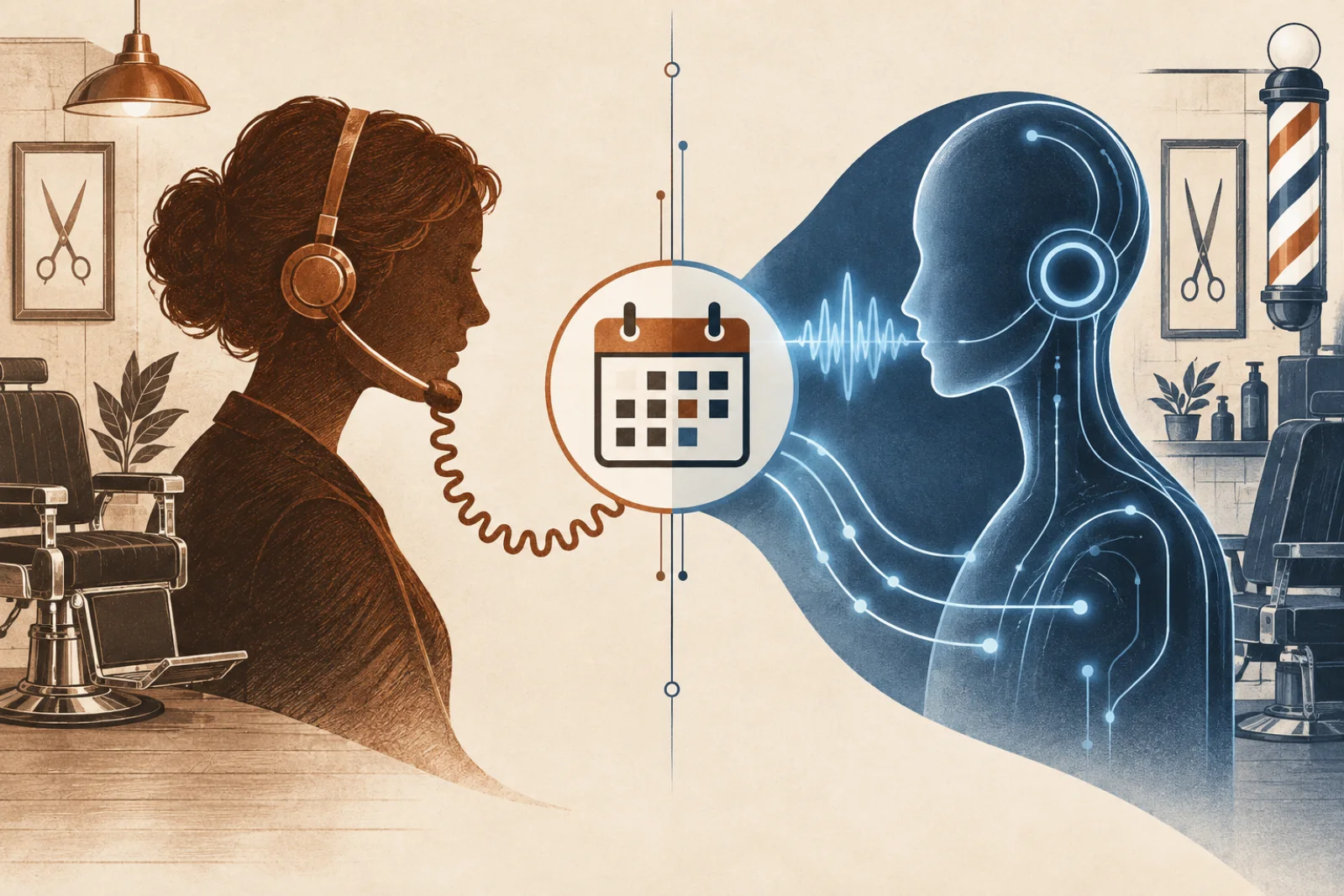
Coco is Blismo's AI phone assistant for barbershops and salons. She answers calls 24/7 in natural conversation, works out what the caller needs, checks the live calendar, and books the appointment during the call — then sends a text confirmation. She is part of Blismo rather than a standalone phone service, which is why she can complete a booking rather than pass on a message.
The Three Options Barbershops Actually Choose Between
Most shops end up picking one of three things, often without comparing them directly:
- Voicemail — free, and almost entirely ineffective.
- A human answering service — a real person answers, takes a message, and passes it on.
- An AI receptionist — answers, resolves the request, and books.
The distinction that matters is not "human versus robot." It's whether the call ends with an appointment or with a task for you.
What a Human Answering Service Actually Costs
Headline pricing looks reasonable and real bills usually aren't, because these services bill by the minute:
- Entry plans start around $50–$100/month, but included minutes run out fast (Alliance Virtual Offices, 2026).
- Typical per-minute rates: Ruby ~$4.90/min, AnswerConnect ~$3.25/min, PATLive ~$2.65/min (NextPhone, 2026).
- Overage rates run $1.25–$2.50/minute once the allowance is gone (NextPhone, 2026).
- Realistic monthly cost at typical small-business volume: $400–$700/month (NextPhone, 2026).
For comparison, hiring an actual receptionist runs $2,800–$4,500/month (NextPhone, 2026), which is why most independent shops never seriously consider it.
Side-by-Side
| Voicemail | Human Answering Service | AI Receptionist (Coco) | |
|---|---|---|---|
| Typical monthly cost | Free | $400–$700 at real volume | $99–$299 industry average; Blismo from $29.99 |
| Billing model | — | Per minute, with overages | Flat monthly |
| Answers the call | No | Yes | Yes |
| Knows your services and prices | No | Only from a script you supply | Yes — from your configured menu |
| Sees your live calendar | No | Usually not | Yes |
| Completes the booking | No | No — takes a message | Yes |
| Handles reschedules | No | Message only | Yes |
| Available 24/7 | Yes (uselessly) | Depends on plan | Yes |
| Cost rises with call volume | — | Yes, sharply | No — flat |
| What you get afterwards | Nothing | A list of people to call back | A filled calendar |
The Real Difference Isn't Cost — It's the Callback
A human answering service does the first half of the job well: someone friendly picks up, so the caller doesn't hit voicemail. Then it hands the second half back to you.
You still have to read the messages, work out availability, call the client back, reach them (they're now at work, or driving), and book the appointment.
Each of those steps loses people. And the callback happens hours later, when the client has often already booked somewhere else — which is the same failure voicemail produces, just delayed and paid for.
An AI receptionist removes the handback entirely. The caller wanted an appointment; they finish the call with one.
When a Human Answering Service Is Still the Better Choice
To be fair about it: there are cases where a live agent wins.
- Complex or sensitive calls — complaints, disputes, anything emotionally charged is better handled by a person.
- Highly non-standard requests that fall outside normal booking and service questions.
- Businesses where the phone conversation is the service — legal intake, medical triage, and similar.
For a barbershop, the overwhelming majority of calls are: do you have anything Thursday, how much is a fade and beard, can I move my appointment, do you take walk-ins. Those are exactly the calls automation handles well — and exactly the calls a message-taking service handles worst, because each one becomes a callback.
Which Option Fits Your Shop
| If your situation is... | The sensible choice | Why |
|---|---|---|
| Calls ring out during peak hours and after closing | AI receptionist | The gap is availability, and message-taking doesn't close it |
| You already have a front desk covering open hours | AI receptionist for after-hours only | Fills the uncovered window without duplicating a role |
| Most calls are routine bookings and price questions | AI receptionist | These are exactly the calls automation completes rather than defers |
| You get a high share of complaints or complex situations | Human service, or AI with escalation | Sensitive conversations belong with a person |
| Call volume is very low (a handful a week) | Voicemail may genuinely be enough | Not every shop needs to solve this |
| You're a multi-location group | AI receptionist | Per-location human coverage multiplies cost; AI doesn't |
The row worth pausing on is the last-but-one. Not every barbershop has a missed-call problem worth paying to fix — if your phone rings four times a week and you catch most of them, this isn't your bottleneck. The case is strongest for shops where the phone rings during exactly the hours nobody can pick up.
A Note on Comparing Quotes
If you do price a human answering service, ask two specific questions that headline pricing tends to obscure:
- What's the per-minute rate after the included allowance? This is where the real cost lives — overages of $1.25–$2.50/minute add up quickly at barbershop call volumes.
- How is a "call" counted? Some services bill in 30-second increments and round up, which materially changes the effective rate on short booking calls.
Both questions tend to move a quoted $99/month closer to the $400–$700 range that reflects actual usage.
What It Costs a Barbershop to Get This Wrong
Working through it with typical numbers: at $400–$700/month for a live service, a shop is spending $4,800–$8,400 a year to receive a list of people to phone back — on top of the staff time spent actually phoning them back.
The same shop on Blismo's entry tier at $29.99/month spends around $360 a year and gets bookings rather than messages. Even accounting for the cases where a human would handle a call better, the gap is difficult to justify on volume alone.
Frequently Asked Questions
How much does an answering service cost for a barbershop?
Entry plans advertise $50–$100/month, but at realistic call volumes the true cost runs $400–$700/month because these services bill per minute with overages of $1.25–$2.50/minute.
Is an AI receptionist cheaper than an answering service?
Substantially. Most AI receptionists run $99–$299/month for full 24/7 coverage, and Blismo starts at $29.99 — against $400–$700 for a live service at comparable volume.
Can an answering service book appointments for me?
Usually not. Most take a message and pass it on, because they don't have access to your live calendar. That leaves the actual booking as a callback task for your team.
Is a human better at handling clients than AI?
For complaints and unusual situations, yes — which is why escalation matters. For the routine questions that make up most barbershop calls, the more relevant comparison is a completed booking versus a message you have to act on later.
What happens when Coco can't handle something?
Well-designed systems escalate to voicemail or a callback request rather than improvising. Anything genuinely complex should reach a person.
Do I keep my existing phone number?
Most modern AI receptionists work with your existing number rather than requiring a new one. Confirm the setup for your shop at blismo.com.
Should I use both?
Some businesses do — AI for routine volume, a human service for escalations. For most independent barbershops the routine volume is nearly all of it, so the second layer rarely earns its cost.
What about hiring an actual receptionist?
At $2,800–$4,500/month, it's rarely viable for an independent shop — which is the practical reason this comparison usually comes down to answering service versus AI.