
Why Nail Salons Break Generic Salon Software
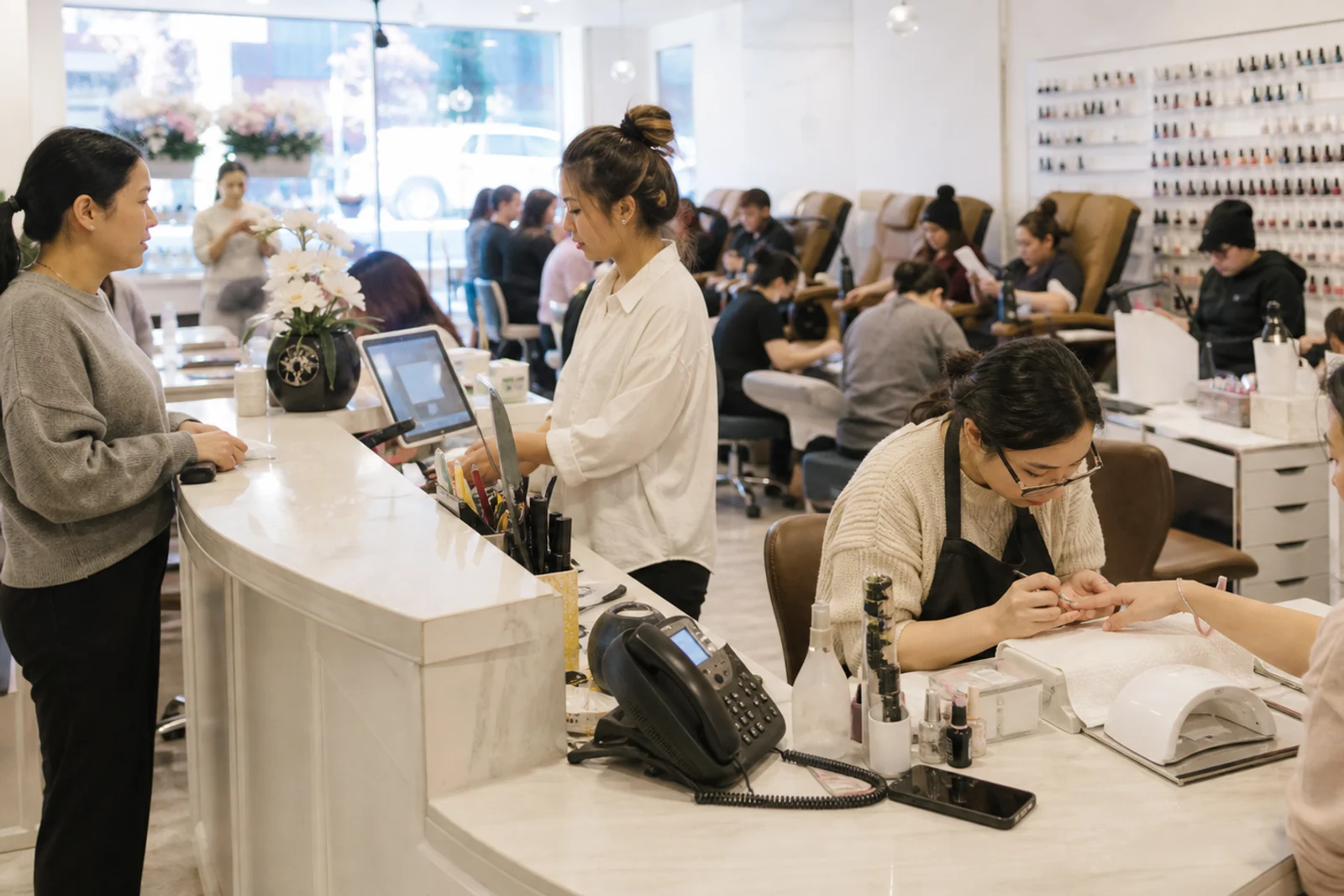
You'll see this category sold under several names — nail salon booking software, nail salon management software, nail salon scheduling software, nail salon POS, or just software for nail techs. They describe overlapping things, and the labels aren't a reliable guide to what a product actually does. A “booking” product may have no point of sale; a “management” platform may have no walk-in handling. The checklist further down is a better filter than the name.
A hair salon runs on appointments. A nail salon runs on two demand streams competing for the same chairs — booked clients and walk-ins — with a service menu that combines in dozens of ways and a workforce whose hands are literally occupied for 45 minutes at a time.
Generic salon software is built for the first pattern. Here's where the second one breaks it:
| Hair salon | Nail salon | |
|---|---|---|
| Walk-in share of traffic | Low | 40–60% |
| Service menu size | ~8 services | 40+, and they combine |
| Can staff answer the phone mid-service? | Briefly | No — both hands occupied |
| Service cycle | 4–6 weeks | 2–3 weeks |
| Client follows a specific person | Often | Very often |
| Cost of not returning | Hair grows out | The product fails — gel lifts, acrylics break |
Every row on the right creates a requirement that generic software either handles badly or not at all.
The Four Things That Actually Go Wrong
1. The phone rings and nobody can pick it up
This is the biggest one and the least addressed. A manicure runs around 45 minutes, gel and acrylic work considerably longer, and during that time both of the technician's hands are occupied, the client's hands are in position, and product is curing. There is no twenty-second window.
Meanwhile 60–70% of nail clients book from a phone and 46–50% of appointments are made outside business hours (LeadSuiteNow, 2026). A salon missing 5–10 calls on a peak day loses an estimated $15,000–$45,000+ a year (RingBooker, 2026) — and none of it appears in your POS, because a missed caller never becomes a line item.
Online booking does not solve this. It captures the clients who were already going to self-serve. The people you're missing are, by definition, the ones who didn't.
2. Walk-ins and appointments fight over the same chairs
At 40–60% of daily traffic, walk-ins aren't overflow — they're half the business. But most scheduling software treats them as an exception: something you squeeze in, not something the system plans around.
The practical failures: booked clients watch their appointment times slip; walk-ins are told “come now” and arrive to a 45-minute wait; and nobody can answer “do you take walk-ins right now?” accurately because the person on the phone can't see the calendar.
3. One service is six different prices
“How much for a full set?” has no single answer:
| Variable | Options |
|---|---|
| System | Gel, dip, acrylic, polish |
| Removal | None, your own set, another salon's set |
| Length | Natural, medium, long, XL |
| Shape | Square, almond, coffin, stiletto |
| Art | None, accent, French, full design |
| Tech tier | Junior, senior, specialist |
Software that stores “Full Set — $65” as one line item will quote wrong, book the wrong duration, and produce a dispute at checkout. You need line items that combine, with durations attached to each.
4. Fills and full sets are not the same appointment
A fill and a full set differ by roughly double in chair time. Book them as equivalent slots and the schedule collapses by Saturday afternoon. This sounds obvious and it is the single most commonly skipped configuration step.
Three Ways Nail Salons Run the Book
Most salons are in one of three states, and the right move depends on which:
| Paper book / notebook | Generic scheduler | Nail salon software | |
|---|---|---|---|
| Cost | Free | $0–$50/month | $24–$200/month |
| Prevents double-booking | No | Yes | Yes |
| Handles walk-in queue | Manually | Rarely | Should |
| Separate durations per service variant | No | Sometimes | Yes |
| Prices service combinations | No | Rarely | Yes |
| Books a named technician | Manually | Sometimes | Yes |
| Sends reminders | No | Yes | Yes |
| Captures walk-in client details | No | No | Should |
| Answers the phone | No | No | Only a few |
| Client record survives a tech leaving | No | Yes | Yes |
The jump from paper to any software is large and obvious. The jump from a generic scheduler to nail-specific software is narrower and comes down to four things: walk-ins, service variants, technician-level booking, and whether anything covers the phone.
That last column is worth reading carefully. Most nail salon software does not answer calls — it organises the bookings that make it through. In a business where 60–70% of demand starts on a phone nobody can pick up, that leaves the largest leak untouched.
What to Look For — The Nail-Specific Checklist
Beyond the standard scheduling, POS, and reporting every platform has, these are the things that actually separate nail salon software:
- Does it answer the phone?
Most don't. If 60–70% of your bookings start on a phone nobody can reach, the calendar is solving the wrong half of the problem. - Can it price combinations?
Full set + removal + French tips needs three line items added together, not one generic price. - Does it hold separate durations per service variant?
Fill vs. full set, gel vs. acrylic, with and without removal. - Does it manage a walk-in queue alongside the appointment book?
On one screen, not as a workaround. - Can clients book a named technician?
Nail clients follow specific techs more than most service categories. - Does it handle add-ons that change both time and price?
Art, length, shape surcharges. - Does it capture walk-in client details?
A walk-in with no record can't be reminded, rebooked, or reached. This is the cheapest client acquisition you have and most salons throw it away. - Does it prompt the next appointment on a real cycle?
Fills come due at 2–3 weeks, not “sometime.” - Does it handle tips and commission splits?
Including booth-rent arrangements if you have them. - What does it cost at your actual size?
Per-technician pricing scales very differently from flat pricing once you're past three chairs.
What Nail Salon Software Costs
The category spans a wide range, and the pricing model matters more than the headline number.
| Platform | Base price | How it scales |
|---|---|---|
| Vagaro | $23.99/month (1 calendar) | +$10/month per calendar 2–7; unlimited free from the 8th |
| Booksy | $29.99/month + tax | +$20/month per extra user; Boost is optional and charges a 30% one-time commission on a new client first visit |
| Fresha | $19.95/month solo, or $14.95 per team member | Plus 20% new-client marketplace fee (min $6) and card processing |
| Mangomint | $120/month per location | +$10/month per user (changed 1 Aug 2026) |
| Zenoti | Custom / enterprise | — |
| Blismo | $29.99 / $69.99 / $119.99 (Starter / Standard / Pro) | Up to 1 / 4 / 8 accounts |
Pricing as published at time of writing. Mangomint changed its model on 1 August 2026; Fresha is no longer a free-core product. Verify before comparing.
What a six-technician salon actually pays
Headline prices mislead badly once you scale. Same salon, six techs:
| Platform | Monthly at 6 techs |
|---|---|
| Vagaro | $23.99 + 5 × $10 = $73.99 (before add-ons) |
| Fresha | 6 × $14.95 = $89.70 + 20% on new marketplace clients + processing |
| Booksy | $29.99 + 5 × $20 = $129.99 (before tax; Boost charges a 30% one-time commission on a new client first visit) |
| Mangomint | $120 + 6 × $10 = $180 |
| Blismo | $119.99 (Pro) |
Three things to check on any quote:
- Per-technician or per-calendar scaling. A $24 base plan across six techs is not a $24 plan.
- Add-ons. Vagaro charges separately for text marketing ($20), website builder ($20), forms ($10), online cart ($10), and integrations ($30–40) — those can double the base.
- Commission on new clients. Fresha takes 20% (minimum $6) of marketplace bookings. At 30 new clients a month on a $70 ticket that's $420/month — more than any subscription on this list.
Where Blismo Is Different
Blismo is a booking platform with an AI phone assistant built into it, rather than a scheduling tool with a phone number attached.
The practical difference is what happens to the 60–70% of demand that arrives by phone:
- Coco answers every call, 24/7, in natural conversation — including evenings and closed days, where roughly half of booking intent sits.
- She answers from your real service menu, so “how much for a full set with removal” gets the correct combined price.
- She checks the live calendar and books during the call, rather than taking a message.
- She answers walk-in questions accurately — “we're full until 4, but I can book you at 4:15” turns a rejection into an appointment.
- Smart Rebooking follows the 2–3 week fill cycle, prompting the next appointment before the window closes.
For shops running Blismo, the company reports a 100% answer rate, up to 80% higher client retention, and around 10% monthly client growth. These are Blismo's own figures rather than independently audited results and vary by shop — ask for methodology before treating them as a forecast.
Why the phone matters more than the feature list
The rebooking benchmark for this industry is stark: the average salon rebooks 40% of clients; top performers reach 69% (JeriCommerce, 2026). At 400 appointments a month and a $106 average ticket, closing that gap is worth roughly $12,300 a month — from clients already sitting in your chairs.
Meanwhile acquiring a new client costs 5–7× more than keeping one, and 42% of returning clients generate 80% of salon revenue. Software that only organises the calendar doesn't touch either number. Software that answers the phone and drives the next booking does.
What Fits by Salon Size
The right answer changes with the shape of the business, not just headcount.
Solo tech or booth renter. You have no front desk at all, so every call during a service is missed — the gap is proportionally larger than in a big salon. Booth rent averages $252–$400 a week and some salons charge extra to take your bookings, which prices the alternative clearly. What you need is phone coverage and a booking link, not a management suite.
Two to four chairs. The common case, and where walk-ins and appointments start genuinely competing. Priorities: walk-in queue on the same screen as the book, accurate per-variant durations, and phone coverage during peak hours. Watch per-technician pricing — it starts to bite here.
Five or more chairs, or a front desk. You have someone answering calls during open hours, so the gap moves to evenings and closed days — where 46–50% of booking demand sits. Technician-level scheduling and commission handling matter more at this size.
Multi-location. The economics change: a receptionist is a per-location hire, software isn't. Check that the platform handles location-specific menus, hours, and staff rather than forcing one shared configuration.
What Software Won't Fix
Being straight, because this category oversells:
- It won't bring in clients who don't know you exist. That's Google Business Profile, reviews, and search visibility — separate work.
- It won't fix a service problem. Clients who don't return because they didn't like the work aren't a scheduling issue.
- It's only as good as the menu behind it. Wrong prices or durations produce wrong answers on the phone and a broken calendar.
- It won't stop cancellations. Deposits and policy do that; software just applies them consistently.
- Switching costs real time. Budget for it honestly rather than expecting a weekend.
Choosing and Switching
Work out your own missed-call number first. Pull the missed-call log from your phone for one busy day, multiply by days open and by 52, assume 40% would have booked, multiply by your average ticket. If that number is small, the phone isn't your bottleneck and you should optimise something else.
Then configure these five things properly, whichever platform you choose:
- Service menu with the distinctions clients ask about — fill vs. full set, gel vs. dip vs. acrylic, removal as its own line
- Accurate durations per variant
- Technician-level availability
- Add-on pricing for art, length, and shape
- Your walk-in policy
Getting those right is most of the value. Getting them wrong is why most implementations disappoint.
Frequently Asked Questions
What is nail salon software?
A platform that runs the salon's daily operations — appointment booking, walk-in queue, point of sale, technician scheduling, tips and commission, client records, and marketing. The nail-specific parts are walk-in handling, combinable service pricing, and per-variant durations.
How much does nail salon software cost?
From free to $200+/month. Vagaro starts around $23.99 and scales per staff member; premium platforms run $165–$175; Blismo starts at $29.99. Check per-technician scaling and payment fees before comparing headline prices.
What's the best nail salon software?
It depends on what's actually broken. If your calendar is a mess, any modern platform helps. If your phone rings out during peak hours — which is the common case at 60–70% phone bookings — you need one that answers calls, and most don't.
Do I need software if I only have three technicians?
Probably, but the deciding factor is call volume and walk-in mix rather than headcount. A three-tech salon that misses six calls a day is losing more than the subscription costs.
Can nail salon software handle walk-ins?
Better platforms manage a walk-in queue alongside the appointment book on one screen. Ask specifically — many treat walk-ins as a manual workaround, which fails at 40–60% of traffic.
Why do nail salons miss so many calls?
Because the work occupies both hands for 45 minutes or more with timing-critical steps. It's a physical constraint, not a discipline problem, which is why “answer the phone faster” never fixes it.
How much revenue do missed calls cost a nail salon?
Estimates put it at $15,000–$45,000+ a year for a salon missing 5–10 calls on a peak day. It's invisible in POS reporting because a missed caller never becomes a line item.
Can software quote a full set with removal and nail art correctly?
Only if it stores those as separate combinable line items with their own durations. A single “Full Set — $65” entry will quote wrong and book the wrong amount of time.
Does online booking replace phone answering?
No. Online booking serves clients who intend to self-serve. The phone carries the questions, reschedules, group bookings, and specific-tech requests — which are also the higher-value bookings.
Can clients book a specific nail technician?
They should be able to. Nail clients follow specific techs more than most categories, and software that treats all availability as interchangeable will book them with the wrong person.
How often should nail clients rebook?
Fills come due at 2–3 weeks. That means a retained client can visit 12–20 times a year — worth $1,270–$2,120 annually at a $106 average ticket.
What's a good rebooking rate for a nail salon?
The industry average is around 40%; top performers reach 69%. If you're near the average, that gap is the largest revenue opportunity in the business.
Does nail salon software reduce no-shows?
Indirectly, through automated confirmations and reminders. Beauty no-show rates run 15–30%; reminders are the standard first countermeasure and deposits the second.
Is free nail salon software worth it?
Free platforms typically monetise through payment processing fees or a cut of new-client bookings. At volume that often costs more than a flat subscription — run the numbers on your actual transaction mix.
What should I ask before buying?
Does it answer the phone; can it price service combinations; does it hold separate durations per variant; can it manage a walk-in queue; can clients book a named tech; and what does it cost at my actual staff count?
How long does it take to switch?
The work is in configuration — service menu, durations, staff availability, add-ons, walk-in policy. Budget real time for those five rather than expecting to migrate over a weekend.
Does Blismo work for nail salons specifically?
Yes. The nail-specific parts are the AI phone assistant answering calls technicians can't take, service-menu pricing that handles combinations, and rebooking that follows the 2–3 week fill cycle.
Does the AI phone assistant speak Spanish?
Blismo's phone assistant supports English and Spanish. Confirm current language coverage before relying on it for a specific market.
What if my technicians rent booths?
Check how the platform handles commission splits and booth-rent arrangements, and who owns the client record. That last question matters more than most owners realise.
Can it capture walk-in clients into the client list?
It should. A walk-in with no record can't be reminded or rebooked — which means the cheapest acquisition channel you have produces nothing repeatable.
Do I still need a website?
Yes, primarily as a price list. Nail clients arrive with two questions — what does it cost and can I get in — and each service you name is a separate search someone makes.
What's the difference between nail salon booking software and nail salon management software?
In practice the labels overlap and aren't reliable. “Booking” products sometimes have no point of sale; “management” platforms sometimes have no walk-in handling. Judge by the checklist above rather than the category name.
Do I need a separate nail salon POS, or is it built in?
Most modern platforms include point of sale. The nail-specific requirement is that checkout handles tips, commission or booth-rent splits, and retail — and that it prompts the next appointment while the client is still there.
Is there software for nail techs who rent a booth rather than own the salon?
Yes, and it's a different need — phone coverage and a personal booking link rather than a full management suite. The question worth asking any vendor is who owns the client record if you move salons.
Can I switch platforms without losing my client list?
You should be able to export clients and appointment history. Ask about export format before you sign, not after — this is the most common thing salons discover too late.
What about scheduling software that isn't nail-specific?
It works if your book is simple. It starts failing at the four points above: walk-in volume, combinable pricing, per-variant durations, and technician requests. If none of those are problems for you, a generic scheduler is fine.
How do I know if the phone is actually my bottleneck?
Pull the missed-call log for one busy day, multiply by days open and by 52, assume 40% would have booked, and multiply by your average ticket. If the number is small, spend your effort on visibility instead.