
Why Checkout Matters More Than the Booking Screen
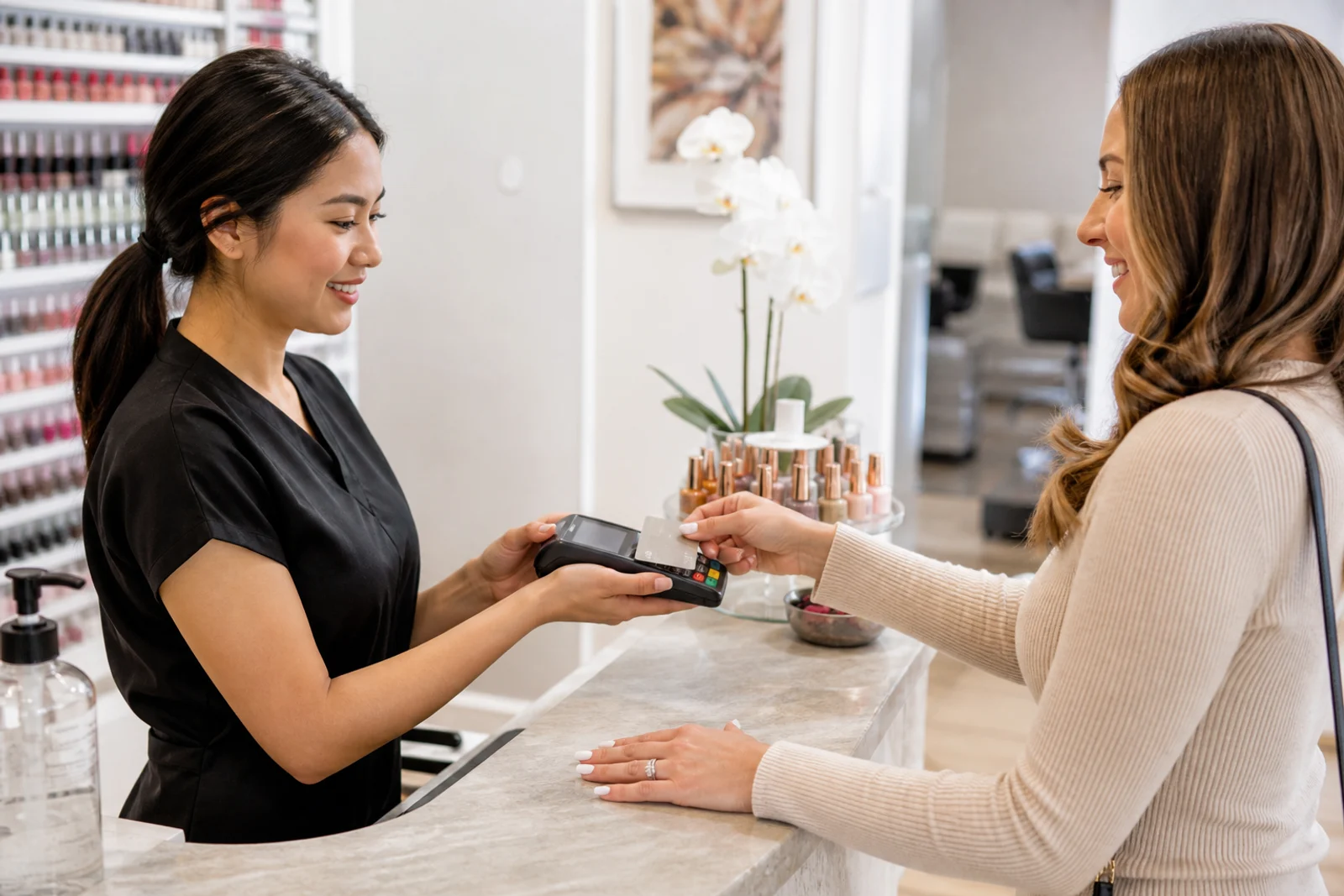
Every platform sells you on the calendar. But the calendar organises decisions that have already been made. Checkout is where the next decision happens, while the client is still standing in front of you, at the moment they are happiest with the work.
Five things have to happen in those 90 seconds:
- The service is priced correctly — including whatever combination they actually had
- Tips are taken and allocated to the right technician
- Commission or booth-rent split is recorded
- The client record is updated — what was done, by whom, with what
- The next appointment is booked
Most setups do the first two. The fifth is where the money is, and it's the one that gets skipped.
The Rebooking Problem Is Physical
Here's the specific reason nail salons rebook worse than they should, and it isn't motivation.
The moment a client is most likely to book their next fill is the moment the set is finished. It is also the moment their hands are wet, curing, or freshly painted and they physically cannot get a phone out to check their calendar.
So it gets deferred — “I'll text you” — and then nobody does.
That's a hardware problem disguised as a sales problem. It's why “train the team to always ask” produces a week of improvement and then reverts. The checkout flow has to do the work, not the technician's memory.
| What usually happens | What should happen | |
|---|---|---|
| Client's hands | Wet or curing | Irrelevant — staff books it |
| The ask | “I'll text you” | Next fill date offered on screen |
| Timing | Deferred indefinitely | Booked before they leave |
| Fallback | None | Automated prompt at 2 weeks |
| Result | ~40% rebook | Up to ~69% rebook |
What a Nail Salon POS Has to Handle
1. Combination pricing
A full set with removal and French tips is three line items, not one. A POS storing “Full Set — $65” produces a dispute at checkout when the real total is $95.
Requirement: separate, combinable line items with their own prices — system, removal, length, shape, art, and technician tier.
2. Tips, commission, and booth rent
This is the messiest part of nail salon checkout and the most common reason owners change systems:
- Tips by card, split correctly per technician, with a clear record for payroll
- Commission at the right percentage, ideally different by service type or tech tier
- Booth rent arrangements, where the technician keeps the revenue and the salon takes rent — a completely different flow from commission
Ask any vendor to demonstrate all three. Many handle commission well and booth rent badly.
3. Walk-in capture
Walk-ins are 40–60% of nail salon daily traffic (Zenoti, 2026). They arrive with no client record, pay, and leave — and most salons never capture a name or number.
That is the cheapest acquisition channel in the business being thrown away at the register. The client already found you, chose you, and paid. Capturing a phone number at checkout turns a transaction into a client you can rebook.
4. Retail
Nail salons sell product — files, oils, at-home kits, polish. Retail is a real margin line and it dies at checkout when it isn't prompted. A POS that surfaces “client bought cuticle oil last visit, 6 weeks ago” converts far better than a technician remembering.
5. The next appointment
Covered above, and it's the one that matters most.
Fill Cycles Make This Urgent
Nail rebooking has a deadline other beauty services don't. Fills come due at 2–3 weeks, and missing it isn't cosmetic — gel lifts and catches, acrylics grow out unbalanced and break. The product fails.
So the client who misses week three doesn't drift back at week five. They get frustrated, take the set off — often badly, at home — and book the next one wherever is quickest.
That narrow window is why checkout and follow-up have to work together:
- At checkout: offer the specific date, 2–3 weeks out, not “see you soon”
- If they don't book: an automated prompt before the window closes, not after
At 12–20 visits a year and a $106 average ticket, one retained client is worth $1,270–$2,120 annually. Losing one isn't losing $106.
POS Checklist for a Nail Salon
| Requirement | Why it matters |
|---|---|
| Combinable service pricing | One service is six different prices |
| Per-variant durations carried through | Fill vs. full set is roughly double the time |
| Tip capture and per-tech allocation | Card tips are most tips |
| Commission and booth-rent splits | Different flows; many systems do only one |
| Walk-in client capture at the register | 40–60% of traffic, mostly unrecorded |
| Next-appointment prompt in the flow | The 40% → 69% gap |
| Retail prompts based on purchase history | Real margin, usually forgotten |
| Works when the client's hands are wet | Staff-side, not client-side |
| Reporting by technician | Commission disputes need a record |
| Exportable transaction history | You will change systems eventually |
What a POS Won't Fix
- It won't fix pricing that's too low. Better checkout on a bad margin is still a bad margin.
- It won't make clients accept a rebooking they don't want. It removes friction; it doesn't create demand.
- It won't answer the phone. The bookings you're missing entirely never reach checkout.
- It won't capture walk-ins if nobody asks. The prompt has to be in the flow and the team has to use it.
Frequently Asked Questions
What does a nail salon POS need that a generic POS doesn't?
Combinable service pricing, per-variant durations, tip and commission or booth-rent splits, walk-in client capture, and a next-appointment prompt built into the checkout flow.
Why is checkout the most important part of nail salon software?
Because it's where rebooking happens. The average salon rebooks 40% of clients and top performers reach 69% — that gap is decided in the 90 seconds at the register.
What's a good rebooking rate for a nail salon?
Around 40% is the industry average; 69% is top-performer territory. At 400 monthly appointments and a $106 ticket, the difference is roughly $12,300 a month.
Why don't nail clients book their next appointment at checkout?
Often because their hands are literally wet or curing and they can't check a calendar. It's a physical constraint, which is why the flow has to book it staff-side rather than relying on the client.
How far ahead should a nail client rebook?
2–3 weeks for a fill. Missing that window isn't cosmetic — gel lifts and acrylics break, so clients frequently remove the set themselves and rebook elsewhere.
Can a POS handle both commission and booth rent?
Some can, many can't do both well. If you have a mix of employed and booth-renting technicians, demo this specifically before buying.
Should I capture walk-in client details at checkout?
Yes — walk-ins are 40–60% of nail salon traffic and most salons never record them. A name and number at the register turns a one-off transaction into a client you can rebook.
Does a POS help with retail sales?
It does if it prompts. Surfacing what a client bought last visit converts far better than a technician remembering, and retail is a genuine margin line in nail salons.
How do card tips get allocated to technicians?
That's a system question worth asking directly. Look for per-technician allocation with a payroll-ready record, not a lump tip total you split manually.
What happens to my transaction history if I switch systems?
Ask about export format before you sign. This is the most common thing salons discover too late.