
About Coco
Coco is Blismo's AI phone assistant for nail salons, barbershops, and beauty businesses. She answers calls 24/7 in natural conversation, works out what the caller wants, checks live availability, and completes the booking during the call — then sends a text confirmation. She isn't a message-taking service. The call ends with an appointment rather than a task for you.
The Phone Is a Bottleneck in Two Different Ways
Most advice about missed calls assumes one problem: you're busy. In a nail salon there are two, and they stack.
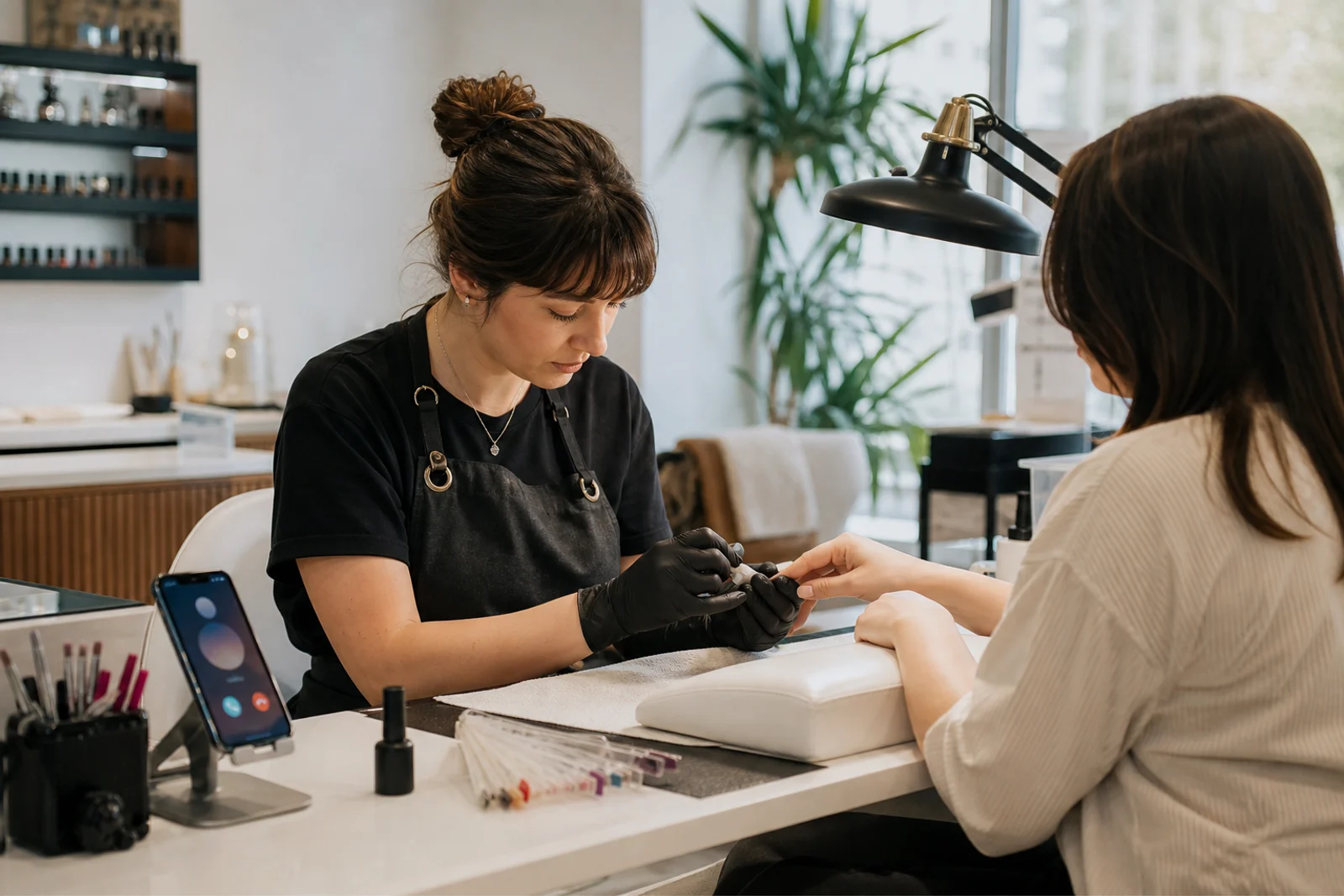
The physical one. A manicure runs around 45 minutes, and gel or acrylic work considerably longer (Zenoti, 2026). During that time both of the tech's hands are occupied, the client's hands are in position, and product is curing. There is no twenty-second window to take a call. Beauty businesses miss an estimated 22–27% of calls as a result (BookingBee, 2026).
The language one. This is real and rarely discussed honestly. The US nail industry was built by Vietnamese immigrant entrepreneurs — an estimated 50–80% of salons nationally, around 80% in California (SNS, 2026). Cosmetology schools have run Vietnamese-language programmes for decades to serve this workforce.
Speaking a second language in person, with context, gestures and a service menu in front of you, is a very different task from taking a fast phone call from a stranger who's talking quickly, using slang, and asking about a price you have to calculate on the spot.
Neither of these is a skill problem. They're structural — which is why "answer the phone faster" has never fixed either one.
What That Costs
The numbers on nail salon phone traffic are lopsided in a way most owners never see:
60–70% of nail clients book from a phone (LeadSuiteNow, 2026).
46–50% of appointments are booked outside business hours (LeadSuiteNow, 2026) — roughly half of all booking intent arrives when the salon is shut.
A salon missing 5–10 calls on a peak day loses an estimated $15,000–$45,000+ a year (RingBooker, 2026).
2026 nail services commonly run $70–$120+ per visit, so each missed call is worth more than it used to be.
And none of it shows up in your reports. Your POS records the appointments that happened. It cannot record the person who rang at 2pm on Saturday, got no answer, and called the salon two doors down.
What Salons Currently Do About It
| Let It Ring | Voicemail | Bilingual Front Desk | AI Assistant (Coco) | |
|---|---|---|---|---|
| Cost | Free | Free | $2,800–$4,500/month for full-time | Included in the platform |
| Answers during service | ✕ | ✕ | ✓ | ✓ |
| Answers after hours | ✕ | Records only | ✕ | ✓ |
| Handles fluent English | — | — | ✓ | ✓ |
| Knows your prices and services | — | ✕ | ✓ | ✓ |
| Completes the booking | ✕ | ✕ | ✓ | ✓ |
| Works when that person is off | — | — | ✕ | ✓ |
| Scales to a second location | — | — | Hire again | ✓ |
The third column is the solution most owners consider, and it does work — while that person is on shift. A single front-desk hire covers maybe 40 hours of the 168 in a week, costs $2,800–$4,500 a month (NextPhone, 2026), takes holidays, and eventually leaves. The half of your booking demand that arrives after closing is untouched either way.
What Coco Does on a Call
Answers on the first ring, in natural English conversation — no menu, no hold music.
Understands the request — new booking, reschedule, price question, or a request for a specific technician.
Answers from your real service menu — fills versus full sets, gel versus dip versus acrylic, removals, add-ons.
Checks the live calendar and offers times that actually exist.
Books the appointment during the call, rather than promising someone will ring back.
Sends a text confirmation, then reminders — which matters when beauty no-show rates run 15–30% (RingBooker, 2026).
Escalates what it shouldn't handle — complaints and unusual situations go to a person.
What Actually Changes Day to Day
| Situation | Now | With Coco |
|---|---|---|
| Saturday peak, every station busy | Rings out, no message | Answered and booked |
| Mid-gel application | Nobody can stop | Handled without interrupting service |
| Caller speaking fast, using slang | Difficult mid-service | Handled in fluent English |
| 9pm enquiry | Voicemail nobody hears until morning | Booked that evening |
| Closed Monday | Missed entirely | Handled |
| "How much for a full set with removal?" | Interrupts a technician to calculate | Answered from your configured menu |
| Client asks for a specific tech | Someone has to check the schedule | Checked against live availability |
The Part Worth Saying Plainly
There's a version of this article that treats an English-speaking phone line as fixing a deficiency. That framing is wrong and worth rejecting.
The people running these salons built an entire American industry from nothing, in a second language, and are running profitable businesses in one of the most competitive local service markets there is. The phone isn't evidence of a shortcoming. It's one friction point in a day that already contains a hundred of them — and it happens to be the one that's now solvable without hiring anyone.
The useful comparison isn't "AI versus a great bilingual receptionist." It's AI versus the phone ringing out during a gel application, which is what happens in most salons today.
Getting the Setup Right
An AI assistant performs in proportion to what it's given. For a nail salon, five things carry most of the value:
A service menu with the distinctions clients ask about — fill vs. full set, gel vs. dip vs. acrylic, removal as its own line.
Accurate durations. A fill and a full set occupy very different chair time. Book them as equivalent and the day collapses.
Technician-level availability. Nail clients follow specific techs more than most service categories.
Add-on pricing — nail art, French, extended designs change both price and time.
Your walk-in policy, because it's one of the most common questions on the phone.
Get those five right and Coco handles the overwhelming majority of inbound calls. Anything past them genuinely should reach a person.
Frequently Asked Questions
What is a nail salon answering service?
Traditionally, a service that picks up calls you can't and takes a message. An AI assistant goes further — it checks your calendar and books the appointment, so the call ends with a booking instead of a callback list.
Why do nail salons miss so many calls?
Because the work occupies both hands for 45 minutes or more, with timing-critical steps. Beauty businesses miss an estimated 22–27% of calls overall, and nail salons sit at the worse end.
Does Coco speak fluent English on calls?
Yes — natural conversational English, at normal speaking pace, working from your configured services and prices.
Can Coco answer in other languages?
Blismo's phone assistant supports English and Spanish. Confirm current language coverage at blismo.com before relying on it for a specific market.
Is this cheaper than hiring a receptionist?
Substantially. A full-time receptionist runs $2,800–$4,500/month and covers roughly 40 hours a week. Coco covers all 168.
How much revenue do missed calls cost a nail salon?
Estimates put it at $15,000–$45,000+ a year for a salon missing 5–10 calls on a peak day — and it's invisible in POS reporting, because a missed caller never becomes a line item.
Will clients know they're talking to AI?
Coco uses natural, low-latency conversational voice. Salons can disclose AI use in the greeting for transparency; it doesn't meaningfully change booking completion.
Does this replace my front desk?
Usually it covers what a front desk can't — peak hours when everyone's hands are full, evenings, and closed days, which is where roughly half of booking demand sits.
Answer every nail salon call
Get Started with Coco
The phone rings while four technicians all have their hands in someone else's. That call isn't going to voicemail — it's going to the salon down the street. Coco answers it instead, in fluent English, and books it.