
About Blismo Smart Rebooking
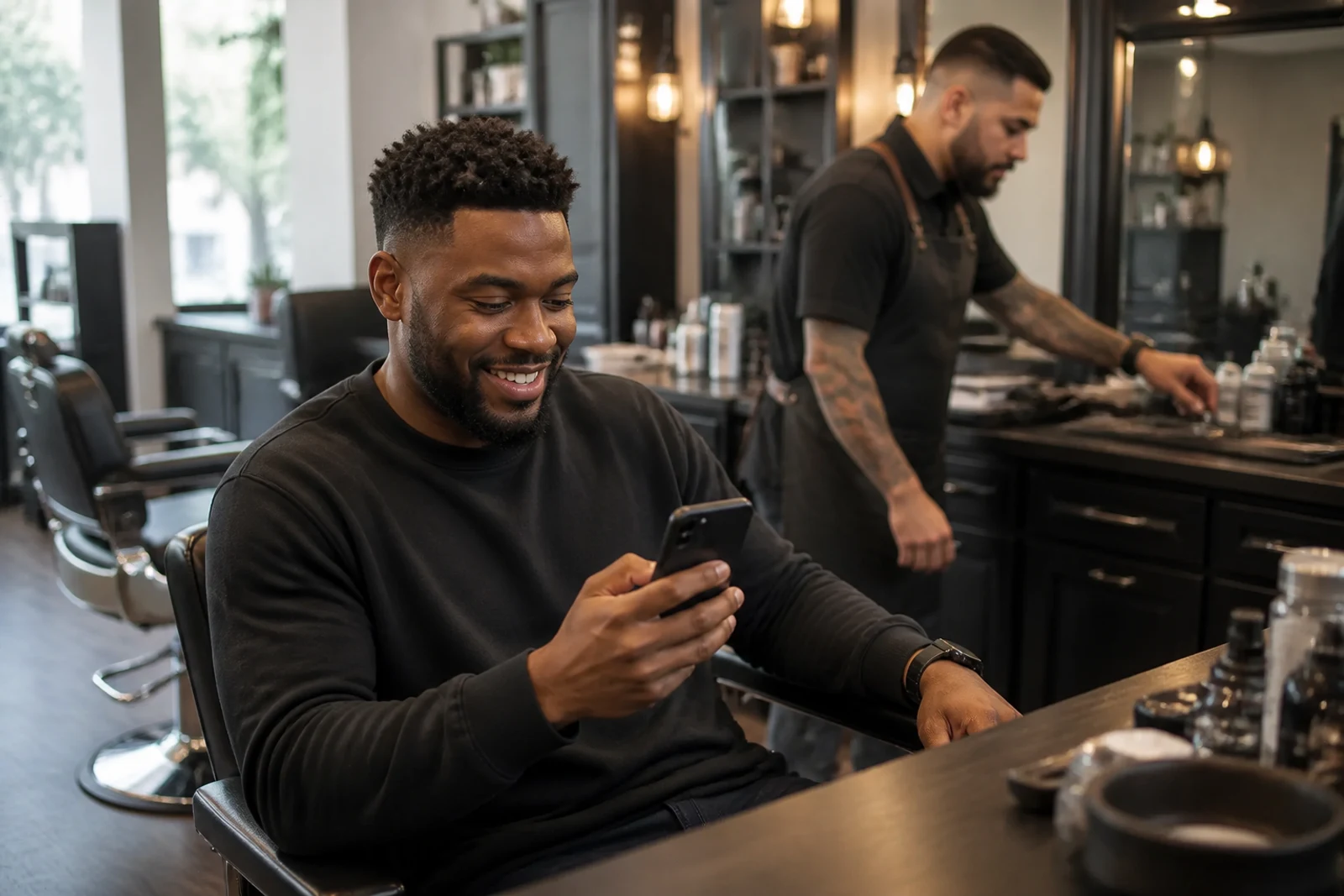
Blismo Smart Rebooking is the retention layer inside Blismo's AI platform for barbershops and salons. It matches open calendar slots with the clients most likely to book — based on their own history and preferences — and sends the outreach automatically, rather than requiring the shop to build lists, write messages, and remember to send them.
The Checkout Moment, and What It Actually Costs
Every barbershop owner knows the ideal: book the next appointment before the client leaves the chair. In practice it happens less than half the time. The client is paying, chatting, checking their phone, unsure of their schedule three weeks out — and the moment passes.
That single moment quietly determines most of a shop's retention outcome:
- 56% of clients don't rebook at checkout (US Tech Automations, 2026).
- Industry benchmarking suggests only around 1% of shops get clients rebooking within 24 hours of a visit, with top performers reaching about 5% (Zenoti 2025 Benchmark Report).
- Reactivation sequences targeted at the non-rebooking group convert an additional 12–18% within 45 days (US Tech Automations, 2026).
The third number is the one worth sitting with. It means a meaningful share of that 56% is recoverable — but only if something happens in the weeks afterwards, and at most shops nothing does.
Where Rebooking Actually Gets Lost
| Stage | What Should Happen | What Usually Happens |
|---|---|---|
| At checkout | Client books the next appointment before leaving | 56% don't — they're unsure of their schedule, or nobody asks |
| First 24 hours | A prompt while the fresh cut is still top of mind | Nothing; only ~1% of shops convert here |
| Weeks 1–3 | Nudge as their normal cycle approaches | Nothing, unless a staff member happens to remember |
| Past their cycle | Direct outreach before they drift | Nothing — and this is where they quietly become someone else's client |
| Months later | Win-back attempt | Occasionally a mass discount blast, which converts poorly |
The pattern is that the entire funnel after checkout is usually empty. Not badly executed — simply absent, because it depends on someone with a full appointment book remembering to do it.
Why the Manual Version Fails
It isn't a knowledge problem. Most owners know they should follow up. The failure is structural:
- You don't know who's due. Knowing that Marcus's client from three weeks ago is now overdue requires checking per client, per week.
- The message has to be personal to work. Win-back sequences that reference the client's specific barber perform meaningfully better than generic blasts — which means it can't be one message copy-pasted to 300 people.
- The timing window is narrow. Reach out too early and it's noise; too late and they've already booked elsewhere.
- It competes with cutting hair. The follow-up work happens in exactly the hours that generate revenue.
Automated vs. Manual Follow-Up
| Manual Follow-Up | Blismo Smart Rebooking | |
|---|---|---|
| Identifying who's due | Weekly manual review of booking history | Automatic, per client |
| Timing | Whenever someone gets round to it | At each client's own due point |
| Message personalisation | Realistically generic at volume | Built around the client's history and barber |
| What happens on a busy week | Nothing gets sent | Unaffected |
| Filling tomorrow's gaps | Ring round and hope | Matches open slots to clients likely to book |
| Staff time required | Hours per week | Effectively none after setup |
What Good Follow-Up Looks Like
The structure that performs in beauty-sector retention work is short and specific rather than promotional:
- A prompt near their normal cycle, not on a shop-wide calendar date.
- Reference to the specific barber they usually see — the personal relationship is the strongest recovery lever.
- A concrete reason to book now rather than a vague "we miss you," ideally tied to real availability.
- Sent by text. SMS open rates run near 98%, against roughly 20% for email.
- Service upgrades over discounts where an incentive is used — a complimentary beard trim or hot towel maintains pricing integrity in a way that 20% off doesn't.
That last point matters more than it appears. Discount-led win-backs train clients to wait for the discount, which turns a one-off recovery into a permanent margin problem.
How Blismo Smart Rebooking Does This Automatically
Those five principles are what Blismo Smart Rebooking is built to execute without anyone at the shop running the process manually:
| The Principle | How Blismo Handles It |
|---|---|
| Contact each client near their own cycle | Learns each client's visit interval from booking history and triggers at their personal due point, not a shop-wide date |
| Reference the specific barber | Pulls the client's usual barber and service from their history rather than sending a generic message |
| Give a concrete reason to book now | Checks actual open slots — including next-day gaps — and offers real times rather than a vague invitation |
| Send by text | Outreach runs over SMS, the highest-response channel for this in the beauty sector |
| Target rather than blast | Matches each open slot to the clients most likely to book it, so messages go to a shortlist instead of the whole database |
The last row is the part that separates this from a mass reminder tool. A blast reaches everyone with the same message regardless of whether they're due; Blismo starts from "what's open tomorrow" and works out who is most likely to take it.
Bookings that come back land directly in the calendar, so nothing needs re-entering by hand.
What This Does to Your Rebooking Rate
Your rebooking rate has two inputs, and most shops only ever work on the first:
Rebooking rate = clients who book at checkout + clients recovered afterwards
Almost every shop tries to improve the first number by reminding barbers to ask. Very few do anything at all about the second, which is why the industry benchmark sits where it does — around 1% of shops get clients rebooking within 24 hours, with top performers at 5% (Zenoti, 2025).
Blismo works on the second input, and it moves the total in three ways:
| Lever | What Changes | Effect on Rebooking Rate |
|---|---|---|
| Outreach happens at all | Currently nothing happens after checkout at most shops | Recovers 12–18% of the 56% who left unbooked |
| Outreach is targeted | Messages go to clients who are actually due, not the whole list | Higher conversion per message, and less list fatigue |
| Outreach offers a real slot | Client gets a specific time rather than a general nudge | Completes the booking in one step instead of starting a conversation |
The Arithmetic on a 400-Visit Month
| Without Recovery | With Automated Recovery | |
|---|---|---|
| Monthly visits | 400 | 400 |
| Leave without rebooking (56%) | 224 | 224 |
| Recovered afterwards | ~0 | 27–40 (12–18%) |
| Extra revenue at $45 average | $0 | $1,200–$1,800/month |
| Annual effect | — | ~$14,000–$21,000 |
And that understates it, because a recovered client doesn't book once — they re-enter the normal visit cycle. Recovering someone on a four-week cycle isn't one haircut; it's potentially twelve a year.
This is arithmetic applied to published industry averages rather than a measured Blismo customer result. Substitute your own visit volume and average ticket for a realistic figure.
The Compounding Effect
Recovering 12–18% of the 56% who don't rebook sounds modest in isolation. Applied continuously, it isn't: those recovered clients re-enter the normal visit cycle, meaning each recovery isn't one haircut but a resumed relationship worth many.
This is also why reactivation is consistently cheaper than acquisition — you're restarting an existing relationship rather than building trust from zero with someone who has never sat in your chair.
Reducing the 56% in the First Place
Recovery matters, but the cheaper win is fewer people entering that group at all. Three things move the number without any software:
- Ask, every time, as part of checkout. Not "see you soon" — an actual question with a proposed date. The barbers who rebook well treat it as part of the transaction rather than an optional extra.
- Propose a specific slot, not an open question. "Same time in three weeks?" converts better than "when do you want to come back?", because it removes the mental work of choosing.
- Make the answer reversible. Clients hesitate to commit three weeks out. Knowing they can move it easily lowers the barrier to saying yes now.
None of this replaces follow-up — a share of clients genuinely can't commit at checkout. But every client who books before leaving is one who never needs recovering.
Frequently Asked Questions
What percentage of clients rebook before leaving the shop?
Industry analysis puts it at around 44% — meaning 56% leave without booking their next appointment (US Tech Automations, 2026).
Can those clients actually be recovered?
A meaningful share, yes. Reactivation sequences run on the non-rebooking group convert an additional 12–18% within 45 days, provided the outreach is timed and personalised rather than a generic blast.
Why don't clients rebook at checkout?
Usually practical reasons rather than dissatisfaction — they don't know their schedule three weeks out, they're mid-conversation, or nobody asks. It's a friction problem, not a loyalty problem.
How soon after a visit should follow-up happen?
Two separate moments matter: a short prompt while the fresh cut is still top of mind, and a second closer to when their normal cycle comes round. The second is where most of the recovery happens.
Should I offer a discount to bring clients back?
Generally prefer a service upgrade — a complimentary beard trim or treatment — over a percentage discount. Upgrades protect your pricing and avoid training clients to wait for offers.
Is text better than email for this?
Substantially. SMS open rates sit near 98% versus roughly 20% for email, which is why text is the default channel for win-back work in this industry.
How is this different from just sending appointment reminders?
Reminders are for appointments that already exist. Rebooking outreach targets clients with no appointment booked at all — a different group, and the one where the revenue is actually leaking.
Does this work for a small shop with one or two barbers?
Small shops arguably need it more, since they have no front-desk capacity to do the follow-up manually. The math is identical; the difference is that a bigger shop might get away with assigning it to someone.