
About Blismo Smart Rebooking
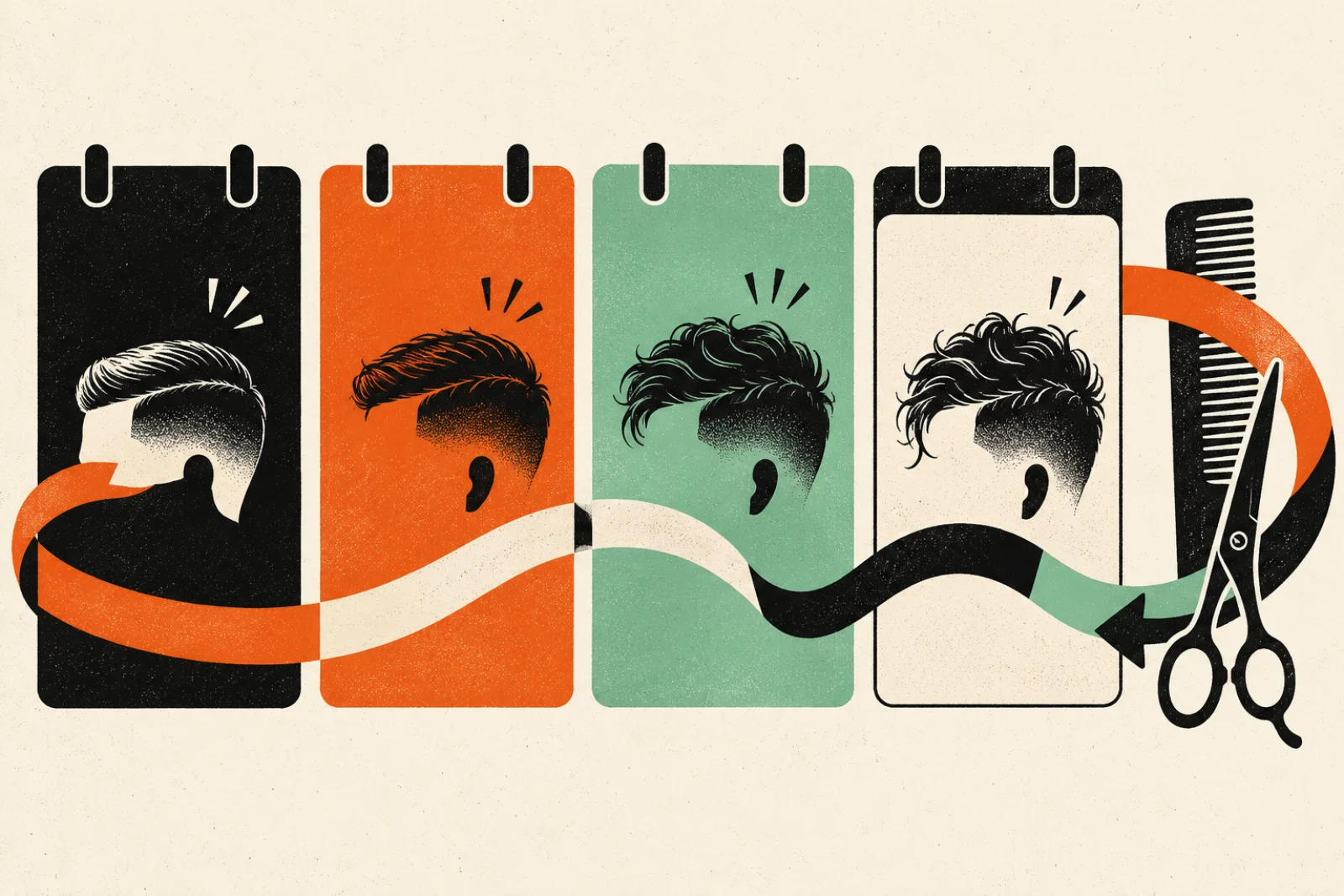
Blismo Smart Rebooking is the retention layer inside Blismo's AI platform for barbershops and salons. Rather than blasting the whole client list on a fixed schedule, it matches open slots with the clients most likely to book based on their own visit history and service preferences — then reaches out automatically at the point each individual client is statistically due back.
Why "Every 4 Weeks" Is the Wrong Default
Four weeks is the number most barbershop owners have in their head, and it isn't unreasonable as an average. The problem is that a barbershop's client base isn't one population — it's several, each with a genuinely different maintenance cycle:
| Service Type | Typical Refresh Cycle | Why |
|---|---|---|
| Skin fade / bald fade | ~2 weeks | The blend grows out fastest and visibly |
| Standard fade / taper | ~3–4 weeks | The classic barbershop cadence |
| Scissor cut / longer style | ~6–8 weeks | Grows out gradually rather than losing shape |
| Beard trim / line-up only | ~2–3 weeks | Often more frequent than the haircut itself |
| Colour or chemical service | ~8 weeks | Regrowth at the root line drives the timing |
A shop that reminds everyone at four weeks is late for its fade clients and early for its scissor-cut clients. Both errors cost money, but in different ways: the late reminder arrives after the client already went somewhere convenient, and the early one trains clients to ignore your messages.
How to Set a Lapse Threshold That Actually Works
The useful distinction is between "due for a visit" and "at risk of being lost." A practical rule used in salon retention work is to set the lapse threshold at roughly 1.3–1.5× the client's normal cycle:
| Client's Normal Cycle | Due for Outreach | Treat as Lapsed |
|---|---|---|
| 2 weeks (skin fade) | ~2 weeks | ~3 weeks |
| 4 weeks (standard fade) | ~4 weeks | ~6 weeks |
| 6 weeks (scissor cut) | ~6 weeks | ~9 weeks |
| 8 weeks (colour) | ~8 weeks | ~12 weeks |
The important part is that this is calculated per client, not per shop. A regular who has come in every three weeks for two years is meaningfully overdue at week five. A client who has always stretched to eight weeks isn't.
What This Means in Practice
Timing matters because most lapsed clients did not leave unhappy. Retention research in the beauty sector consistently finds that clients drift for ordinary reasons — life got busy, they meant to rebook and forgot, nobody reached out. They are not defecting; they're just not being prompted at the moment the thought would have landed.
That's what makes per-client timing valuable rather than merely tidy. A message that arrives the week someone is starting to notice their fade growing out is useful. The same message three weeks later arrives after they've already been somewhere else.
Why Shops Don't Do This Manually
The math above isn't complicated. Doing it for 300 clients, every week, is:
- You'd need to know each client's individual average interval, not the shop average.
- You'd need to check, weekly, who has crossed their personal threshold.
- You'd need to send each of them a message — and the ones that work reference the specific barber they see, which means the message can't be a generic blast.
- You'd need to do this in a week where you're also cutting hair for 40 hours.
This is the gap Blismo Smart Rebooking is built to fill: the calculation and the outreach both happen without anyone at the shop maintaining a spreadsheet.
How Blismo Smart Rebooking Handles the Timing
Rather than running on a fixed calendar, Blismo works backwards from each client's own history:
- It learns each client's interval. Every completed appointment updates that client's personal cycle — a three-week regular and an eight-week regular are tracked separately from day one.
- It watches for the due point. Instead of a shop-wide reminder date, each client crosses their own threshold at their own time.
- It looks at what's actually open. Blismo checks upcoming gaps in the calendar — including tomorrow's — rather than pushing clients toward times you can't offer.
- It matches slots to the right clients. Open times are matched against the clients most likely to book them, based on visit history and service preferences, so outreach goes to a shortlist rather than the whole database.
- It reaches out automatically, referencing the client's usual barber and service rather than sending a generic blast.
- The booking lands in the calendar without anyone at the shop re-entering it.
The practical difference from a standard reminder tool: a reminder system tells everyone the same thing on the same day. This works out who is due, what you have free, and contacts the overlap.
How Better Timing Actually Raises Your Rebooking Rate
The connection between timing and rebooking rate isn't abstract. It works through three specific mechanisms:
- It reaches clients while they're still yours to lose. A fade client contacted at week 2 is deciding when to come in. The same client contacted at week 5 has already dealt with the problem — either at your shop or someone else's. The message is identical; the conversion rate isn't, because one arrives during the decision and the other arrives after it.
- It stops message fatigue from suppressing your good messages. Long-cycle clients who get reminded every four weeks learn that your messages usually aren't relevant, so they stop opening them. That damage isn't limited to the unnecessary messages — it lowers the response rate on the one message that was well-timed. Contacting each client once, at the right point, keeps your open rate intact.
- It converts idle capacity instead of just sending reminders. Because Blismo starts from actual open slots rather than a calendar date, outreach goes out when there's something specific to offer. "We've got Thursday 6pm free" converts differently from "time for a trim?" — the first completes a booking, the second starts a conversation someone has to finish later.
What This Looks Like in Numbers
Take a shop with 400 visits a month. Roughly 56% leave without rebooking (US Tech Automations, 2026) — about 224 clients. Reactivation aimed at that group converts an additional 12–18% within 45 days, which works out to roughly 27–40 recovered bookings a month.
At a $45 average ticket, that's $1,200–$1,800 a month from clients who had already walked out — and because a recovered client re-enters the normal visit cycle, the annual value is considerably higher than the first appointment.
This is arithmetic applied to published industry averages, not a measured Blismo customer result — your own numbers will vary with client base and ticket size.
The Payoff Is Measurable
Structured win-back sequences that reference the client's specific barber recover 20–28% of lapsed clients, and text is the highest-response channel for this in the beauty industry — SMS open rates run near 98%, against roughly 20% for email. Separately, industry benchmarking suggests only about 1% of shops get clients rebooking within 24 hours of a visit, while top performers reach around 5% (Zenoti 2025 Benchmark Report).
That gap between 1% and 5% isn't about haircut quality. It's about whether anything systematic happens after the client walks out.
How to Work Out Your Own Numbers
You don't need software to start — you need one afternoon with your booking history:
- Pull your last six months of appointments and group clients by service type (fade, scissor cut, beard-only, colour).
- For each group, calculate the average gap between visits. Not the average across the whole shop — per group.
- Multiply by 1.3–1.5 to get your lapse threshold for that group.
- Count how many current clients are already past it. This number is usually larger than owners expect, and it's your immediate recovery list.
Step 4 is the one that changes behaviour. Most shops discover a meaningful group of clients who haven't been in for well past their normal cycle, aren't unhappy, and simply haven't been contacted. That's the list worth acting on this week, regardless of what tooling you use.
What Changes When Timing Is Per-Client
| Shop-Wide Reminder Schedule | Per-Client Timing | |
|---|---|---|
| Fade clients (2–3 week cycle) | Reminder arrives late; many already went elsewhere | Arrives as the fade starts growing out |
| Scissor-cut clients (6–8 weeks) | Reminded too often; learn to ignore messages | Contacted once, at the right point |
| Message relevance | Same date for everyone regardless of history | Tied to that client's actual pattern |
| Risk of message fatigue | High | Low |
Frequently Asked Questions
How often should barbershop clients rebook?
It depends on the cut. Skin fades typically need refreshing every 2–3 weeks, standard fades every 3–4 weeks, and scissor cuts or longer styles every 6–8 weeks. Applying a single interval to your whole client base means being late for some clients and early for others.
Is four weeks a reasonable default?
As a shop-wide average, yes — but it's an average of very different behaviours. It works poorly as an operating rule, because the fade clients who make up most barbershop volume are on a shorter cycle than that.
When should I consider a client lapsed rather than just overdue?
A practical rule is 1.3–1.5× their normal cycle. A four-week client is overdue at week five and genuinely at risk by week six; an eight-week colour client isn't at risk until around week twelve.
Why do clients stop coming back?
Usually not dissatisfaction. Retention research in the beauty sector consistently finds clients drift because life got busy and nobody reached out — which is why timely prompting recovers a meaningful share of them.
Should I just send everyone a reminder every four weeks?
It's better than nothing, but it's the approach that produces both problems at once: too late for short-cycle clients, too frequent for long-cycle ones. Frequent irrelevant messages also reduce the odds that your relevant ones get read.
How do I find out each client's actual cycle?
It's in your booking history — the gap between their visits. The obstacle isn't access to the data, it's the time cost of calculating and monitoring it per client every week, which is what automation removes.
Does this apply to salons as well as barbershops?
The principle does, but the numbers differ. Salon cycles are generally longer and more service-dependent (colour versus cut), while barbershops skew shorter and more uniform — which is precisely why a barbershop's shop-wide average feels deceptively usable.
What's the single highest-impact change if I do nothing else?
Stop treating rebooking as one cycle. Even splitting your client list into "short cycle" and "long cycle" groups and timing outreach separately is a meaningful improvement over one shop-wide reminder date.